

Perspectives on New All-Time Highs
Terry Herr, CFP®
It has been an eventful period for financial markets and geopolitics, so I want to take a moment to share some perspective on what it means for your long-term financial plan.
In good news, the stock market has reached several new all-time highs this year, despite ongoing uncertainty surrounding the war in Iran, including an extended ceasefire and failed peace deal attempts. These swings serve as a reminder of how quickly market conditions can change, and why maintaining a steady, long-term approach remains so important.
Markets Often Recover When It’s Least Expected
One of the most consistent lessons from financial history is that markets have a way of surprising investors. They can often rebound exactly when investors are the most pessimistic, and this year is a great example.
At its lowest point in March, the S&P 500 had declined about 9%. Markets then began to recover on positive news in Iran, resulting in a 12% rebound during the first three weeks of April. While the situation is still evolving, this is a reminder that investor sentiment tends to be at its most negative right before markets begin to recover, which is why trying to time the market is so difficult and often counterproductive.
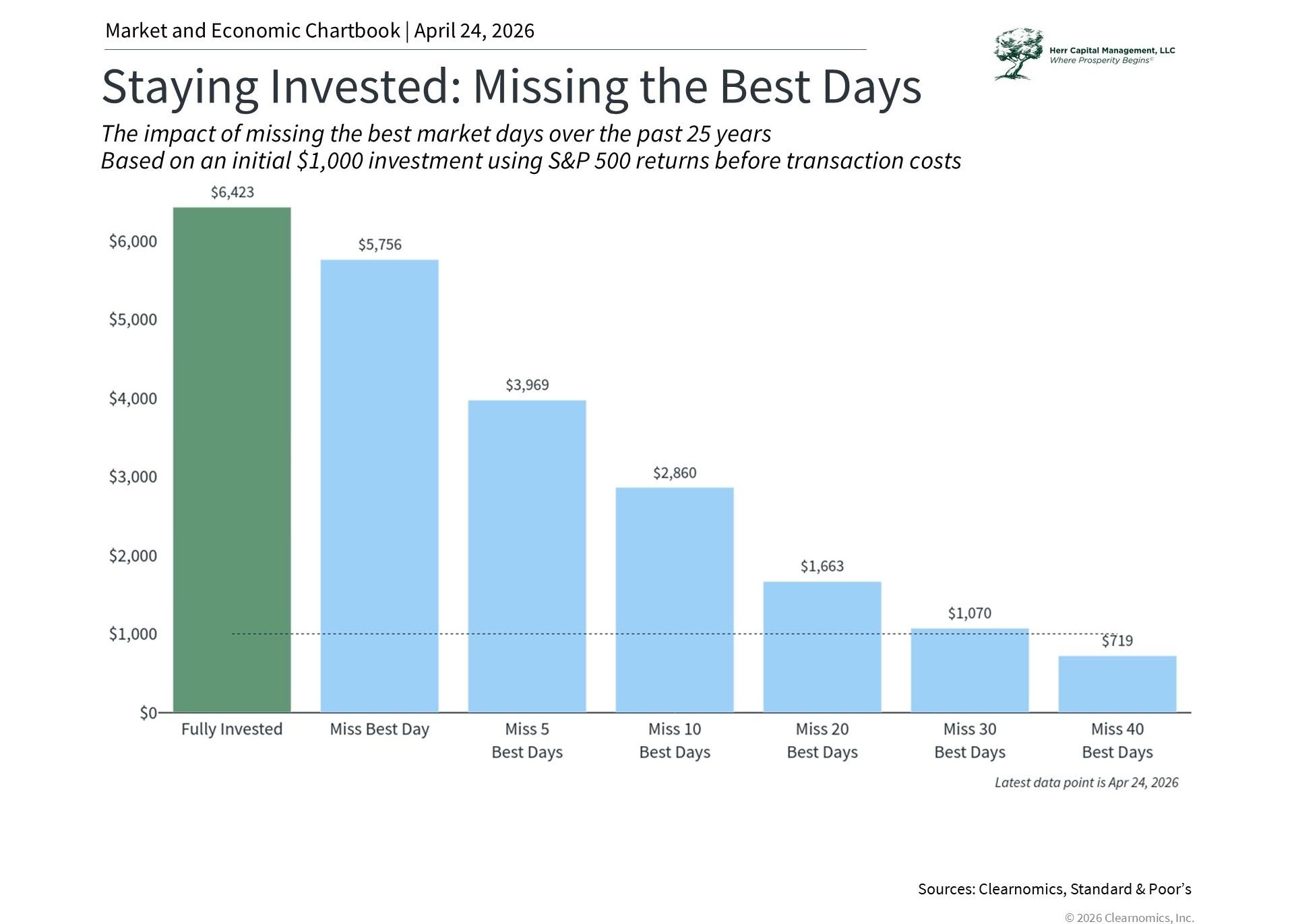
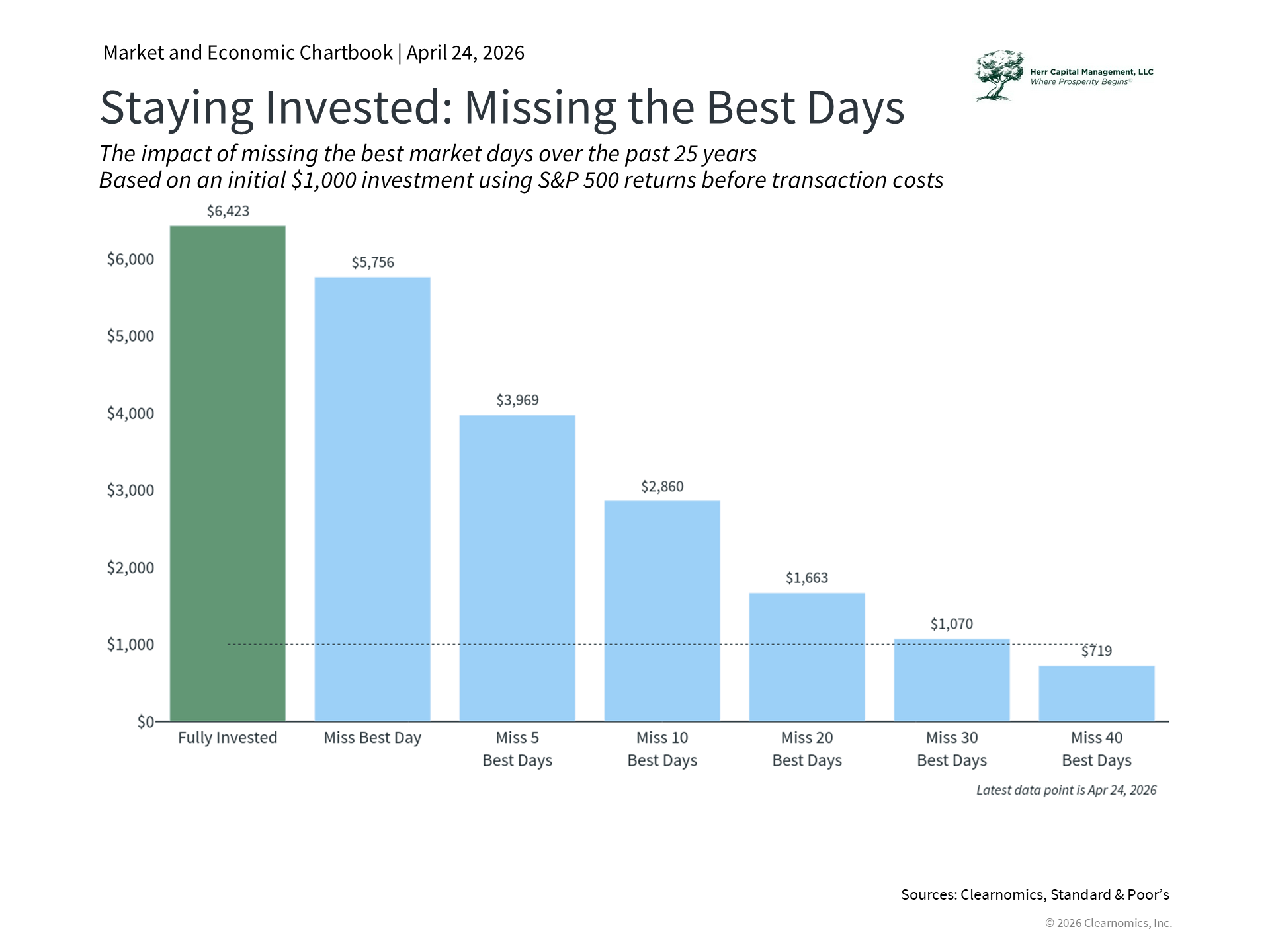
This same dynamic played out last year, when the S&P 500 fell nearly 19% at its worst point due to tariffs. Many investors feared that a sustained downturn and recession were inevitable. Fortunately, neither occurred and markets recovered over the following months. Those who stayed invested were rewarded. This is shown in the following chart, which highlights the difference between sticking to a plan and inadvertently missing positive market days.
 This is not to suggest that markets always rebound quickly, or that every decline is short-lived. What history does show, however, is that reacting to short-term volatility by moving to the sidelines can be costly. The investors who fare best over time tend to be those who remain focused on their goals rather than the daily headlines.
Current Developments
The recent swings in the stock market mostly relate to the evolving situation in Iran and the Strait of Hormuz. Oil prices continue to be volatile, with Brent crude swinging in a wide range from the mid-$80s per barrel to as high as $118. Oil is no longer near its March peak, but it remains well above levels seen before the conflict began.
For everyday consumers, this is also showing up at the gas pump. The national average for regular unleaded gasoline has settled around $4.00 per gallon, which is still about a dollar above the pre-conflict average of $3.00. Filling up the car is a necessity for most households, and higher fuel costs leave less room in budgets for other spending and savings.
A key consequence is higher inflation. The latest Consumer Price Index report for March confirms these challenges. Energy prices jumped 12.5% year-over-year, driven by an 18.9% increase in gasoline prices and a 44.2% rise in fuel oil costs. These are substantial moves.
That said, there is an important distinction worth noting. Core inflation, which excludes food and energy, rose only 2.6%. This suggests that higher energy costs have not yet spread broadly across the rest of the economy. Whether they do so will depend on how long higher prices and the Middle East conflict last. Economists often view these types of supply-driven price shocks as temporary, particularly when they remain concentrated in energy rather than across all categories.
So, the economy is currently mixed, with recent growth balanced against possible inflation concerns. I’d like to emphasize that while this is worth watching, it is a normal challenge in any investor’s journey.
What This Means for Your Portfolio
The possibility of inflation underscores the importance of having a portfolio and financial plan that can not only generate sufficient income, but also grow over time. Your portfolio was designed exactly to withstand these conditions and continues to do its job.
Additionally, a well-constructed portfolio is not built around predicting which areas will lead at any given moment, but to take advantage of all parts of the market. For example, energy-related sectors and commodities have been among the stronger performers this year given the backdrop.
Taken together, the recent rebound in markets is a positive for investors and contains many lessons about the principles of investing success. Of course, we don’t know what may come as the situation evolves in the Middle East, but your financial plan and portfolio are designed for exactly these kinds of environments.
As always, please feel free to reach out if you have questions or would simply like to talk through how any of this relates to your specific situation and goals.
Herr Capital Management, LLC is a registered investment advisor domiciled in Illinois. This content is for information purposes and should not be construed as legal or tax advice and is not intended to replace the advice of a qualified attorney, financial or tax advisor or plan provider. Products or services mentioned on this Site will not be made available to persons resident in any state or territory where such distribution would be contrary to local law or regulation. Copyright (c) 2026 Clearnomics, Inc. All rights reserved. The information contained herein has been obtained from sources believed to be reliable, but is not necessarily complete and its accuracy cannot be guaranteed. No representation or warranty, express or implied, is made as to the fairness, accuracy, completeness, or correctness of the information and opinions contained herein. The views and the other information provided are subject to change without notice. All reports posted on or via www.clearnomics.com or any affiliated websites, applications, or services are issued without regard to the specific investment objectives, financial situation, or particular needs of any specific recipient and are not to be construed as a solicitation or an offer to buy or sell any securities or related financial instruments. Past performance is not necessarily a guide to future results. Company fundamentals and earnings may be mentioned occasionally, but should not be construed as a recommendation to buy, sell, or hold the company's stock. Predictions, forecasts, and estimates for any and all markets should not be construed as recommendations to buy, sell, or hold any security--including mutual funds, futures contracts, and exchange traded funds, or any similar instruments. The text, images, and other materials contained or displayed in this report are proprietary to Clearnomics, Inc. and constitute valuable intellectual property. All unauthorized reproduction or other use of material from Clearnomics, Inc. shall be deemed willful infringement(s) of this copyright and other proprietary and intellectual property rights, including but not limited to, rights of privacy. Clearnomics, Inc. expressly reserves all rights in connection with its intellectual property, including without limitation the right to block the transfer of its products and services and/or to track usage thereof, through electronic tracking technology, and all other lawful means, now known or hereafter devised. Clearnomics, Inc. reserves the right, without further notice, to pursue to the fullest extent allowed by the law any and all criminal and civil remedies for the violation of its rights.