


A View of Inflation and Earnings as the War in Iran Evolves
Terry Herr, CFP®
The conflict between the United States and Iran continues to evolve, with markets reacting to each new set of headlines. A ceasefire announcement initially eased tensions and pushed oil prices lower, with Brent crude falling into the $90 range. However, the subsequent breakdown of peace talks sent prices back above $100 per barrel, reminding investors that the geopolitical situation can change quickly. While the situation remains unstable, the most important question for long-term investors is how they affect the broader economy, businesses, and consumers.
The reality is that geopolitical conflicts tend to affect financial markets through energy prices, which directly impact fuel costs and can then ripple through the economy. How much this affects prices depends on how long energy costs stay high. Understanding these transmission mechanisms can help investors maintain perspective. In particular, inflation, the job market, and corporate earnings, can provide useful insights in today’s market environment.
Energy costs are driving overall inflation higher
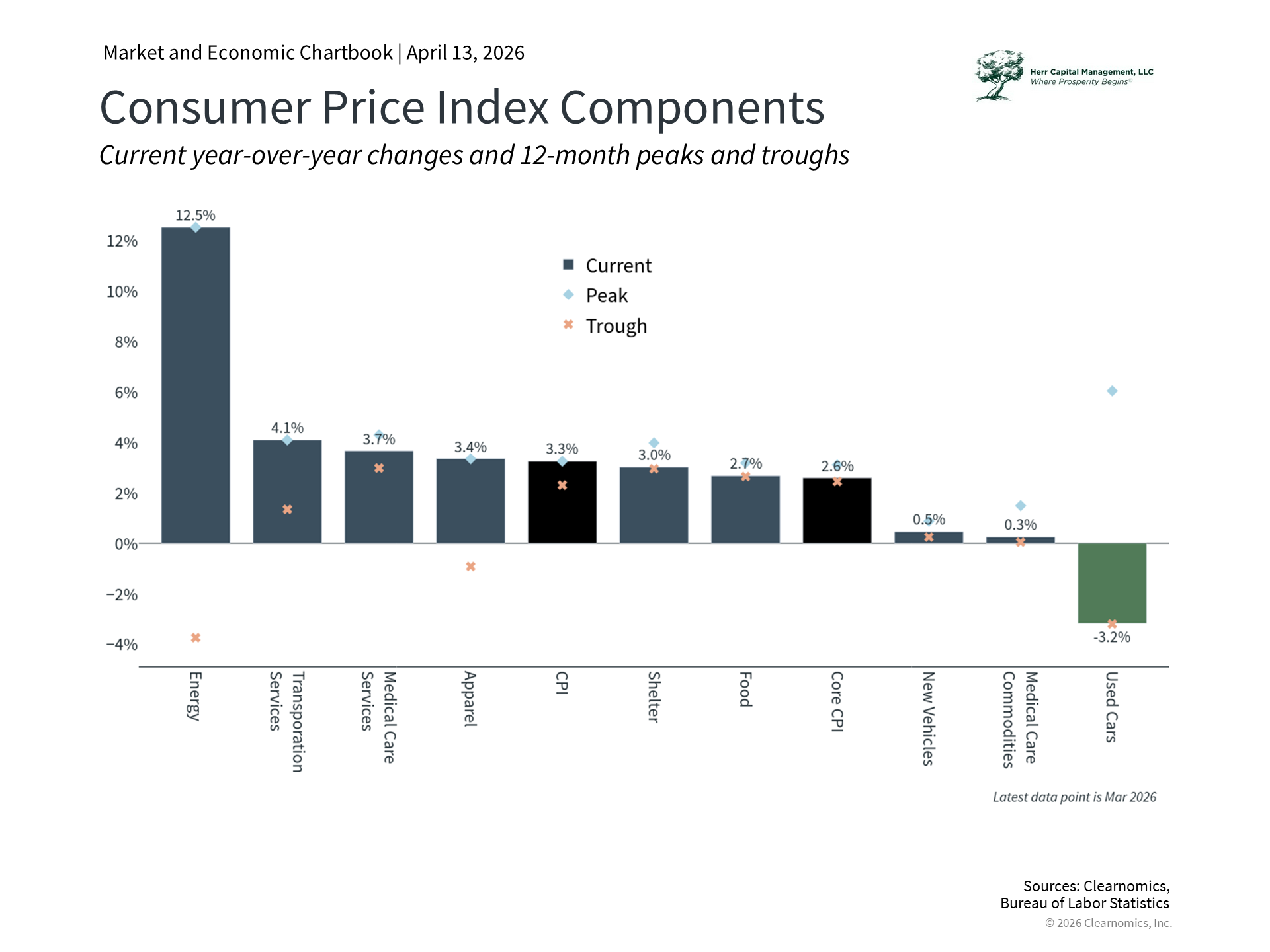 |
The most direct way the Iran conflict is affecting consumers is through higher energy prices. The latest Consumer Price Index report for March showed that energy costs jumped 12.5% year-over-year, with gasoline prices surging 18.9% and fuel oil rising 44.2%. These increases pushed headline CPI to 3.3%, a sharp acceleration that has understandably raised concerns about a return to the inflation environment of 2022. Of course, much of this increase was expected since the conflict in Iran began at the end of February.
What the CPI report also shows is that higher energy costs have not yet spread to other important consumer categories. Core CPI, which excludes food and energy costs, rose only 2.6% year-over-year, which was below consensus expectations and only slightly above the prior month's 2.5%. An even narrower measure that also removes housing costs, sometimes referred to as "supercore" inflation, rose only 2.3%.
These figures suggest that while energy costs are making their way to consumer wallets, with gasoline hitting $4.12 per gallon on average, and much higher in many parts of the country, these pressures have not yet spread broadly across the economy. This distinction matters because the primary economic concern is that if oil prices remain elevated for an extended period, higher energy, transportation, and manufacturing costs could feed into the prices of goods and services more broadly.
Without downplaying the impact higher gasoline prices can have on households, economists tend to view these types of supply-side shocks as temporary. The fact that core inflation has remained relatively stable supports the hope that once the Middle East situation calms, inflation may return to pre-conflict levels. The fact that oil prices fell after the initial ceasefire announcement adds to these hopes as well. However, how quickly that occurs depends on the conflict itself, which remains difficult to predict.
The job market has weakened, but demographics complicate the picture
 |
Beyond inflation, the health of the labor market is another important factor for investors to monitor. The latest employment report showed a positive surprise with 178,000 new jobs added in March, a rebound that exceeded expectations of just 65,000. However, the prior month was revised sharply lower to a loss of 133,000 jobs, a reminder that these figures can be noisy and subject to significant revision.
Stepping back, the broader trend has been one of slowing job creation. Since the beginning of 2025, the economy has averaged only about 21,000 new jobs per month, a significant deceleration from the 122,000 monthly average in 2024. What’s interesting is that the unemployment rate has not risen significantly. In fact, the unemployment rate edged down only slightly to 4.3% in March, but this reflects a shrinking labor force rather than strong hiring.
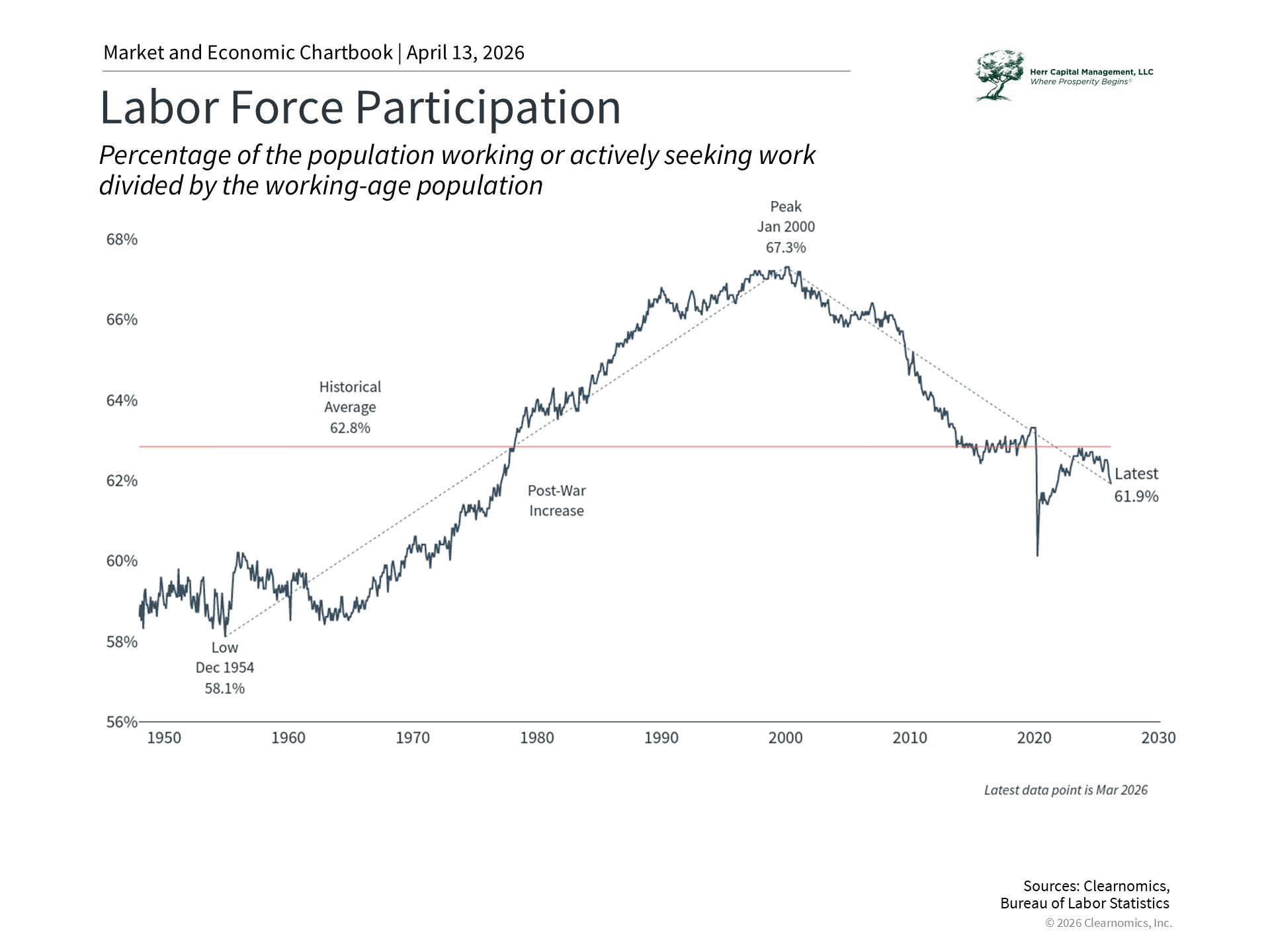
One important way to understand this is via the labor force participation rate, which measures how many Americans that are of working age are actively working or looking for work. As the accompanying chart shows, this rate has declined to just 61.9%, its lowest level since the pandemic. This is not a new phenomenon since labor force participation has been steadily declining since the early 2000s for demographic reasons, particularly an aging population. For example, over 11,000 baby boomers are reaching retirement age every single day.
These demographic trends, along with less immigration, mean that fewer working-age Americans are in the labor force, skewing what economists would have traditionally viewed as a healthy labor market. When fewer people are participating in the job market, the economy requires fewer new jobs each month to maintain low unemployment, which can make the headline figures more difficult to analyze.
Within the details of the monthly jobs report, the picture is also uneven. Much of the recent job growth has been concentrated in the “Education and Health Services” sector, while the “Information” sector has experienced job losses, as seen in layoff announcements by large technology companies. Wage growth has also slowed to 3.4% year-over-year, but this pace is still faster than the overall inflation rate for many workers, providing some support for consumer spending.
What does all of this mean for investors? Consumers are facing higher costs at a time when the job market is weakening. However, the unemployment rate remains stable, suggesting that those who would like to work are finding jobs. It’s simply the case that there is a smaller fraction of the population actively working today than in the past.
Corporate earnings growth remain strong
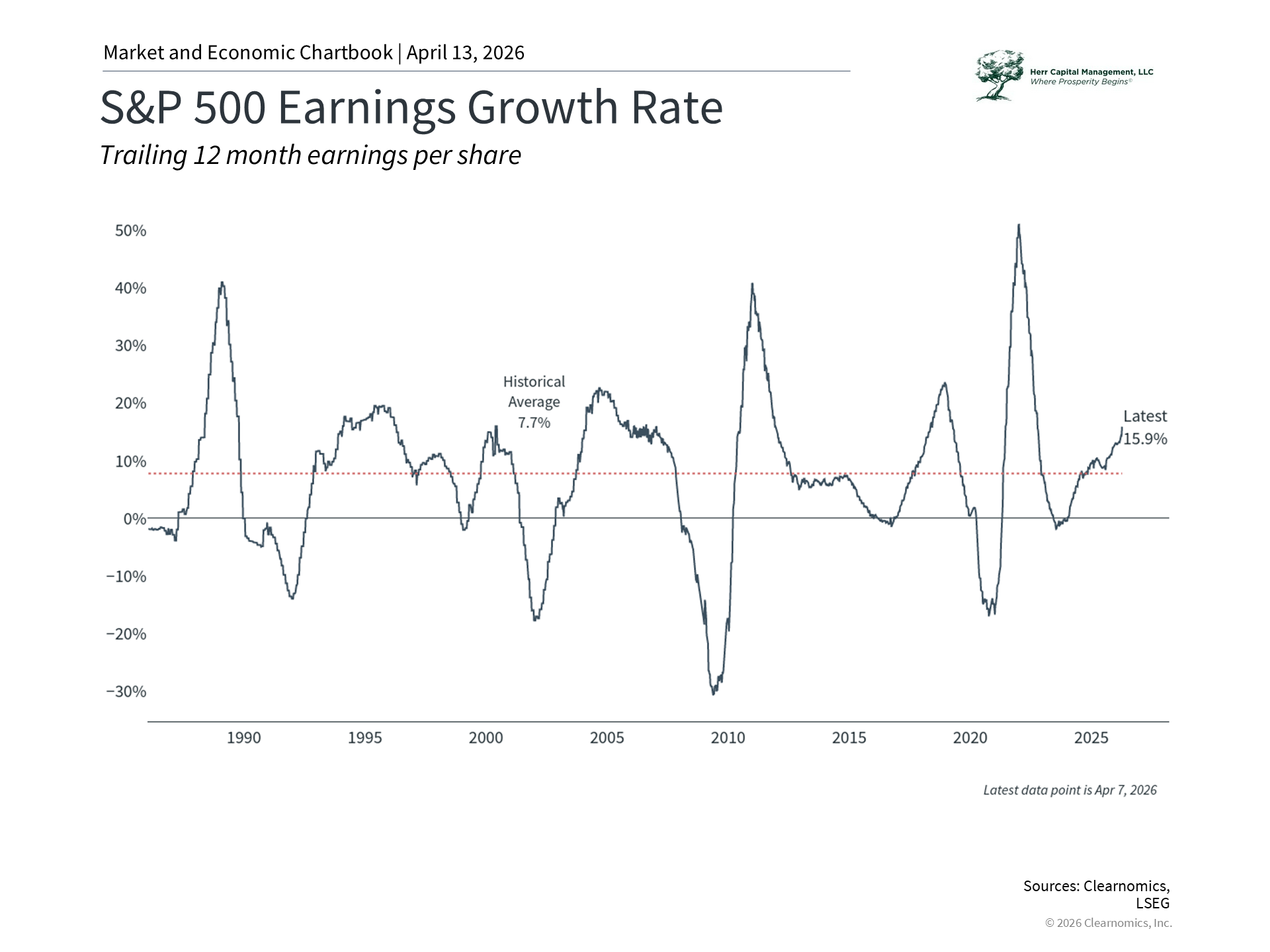 |
Amid the uncertainty around geopolitics, inflation, and employment, one positive area for investors has been the strength of corporate earnings. Despite the challenges described above, what’s interesting is that consumers have continued to spend, and profit margins have remained high for many companies. Current Wall Street estimates suggest that S&P 500 earnings-per-share have grown approximately 16% over the past twelve months, with expectations for an additional 18% growth over the coming year. These are historically strong numbers, well above the long-term average growth rate of 7.7%.
Of course, earnings estimates should always be taken with a grain of salt, as they are based on analyst projections that can change as economic conditions evolve. Tariff policies, higher energy costs, and a slowing job market could all weigh on profitability in the quarters ahead. However, the current trajectory of earnings growth is one reason stock market valuations have improved recently, in addition to the market pullback.
This is a reminder that periods of uncertainty, while they can feel unpleasant, are also when opportunities are the most attractive for long-term investors. When markets experience volatility driven by geopolitical events, it's often the case that earnings expectations don't change as much as stock prices do. While this doesn't mean markets will rebound quickly, it does suggest that investors who maintain a long-term perspective and hold properly diversified portfolios are often rewarded for their patience.
The bottom line? Higher energy prices are affecting the economy, just as consumers face other challenges. However, strong earnings growth and more attractive valuations have created opportunities for investors as well. Maintaining a balanced portfolio and staying focused on long-term financial goals remains the best approach to navigating this environment.
Herr Capital Management, LLC is a registered investment advisor domiciled in Illinois. This content is for information purposes and should not be construed as legal or tax advice and is not intended to replace the advice of a qualified attorney, financial or tax advisor or plan provider. Products or services mentioned on this Site will not be made available to persons resident in any state or territory where such distribution would be contrary to local law or regulation. Copyright (c) 2026 Clearnomics, Inc. All rights reserved. The information contained herein has been obtained from sources believed to be reliable, but is not necessarily complete and its accuracy cannot be guaranteed. No representation or warranty, express or implied, is made as to the fairness, accuracy, completeness, or correctness of the information and opinions contained herein. The views and the other information provided are subject to change without notice. All reports posted on or via www.clearnomics.com or any affiliated websites, applications, or services are issued without regard to the specific investment objectives, financial situation, or particular needs of any specific recipient and are not to be construed as a solicitation or an offer to buy or sell any securities or related financial instruments. Past performance is not necessarily a guide to future results. Company fundamentals and earnings may be mentioned occasionally, but should not be construed as a recommendation to buy, sell, or hold the company's stock. Predictions, forecasts, and estimates for any and all markets should not be construed as recommendations to buy, sell, or hold any security--including mutual funds, futures contracts, and exchange traded funds, or any similar instruments. The text, images, and other materials contained or displayed in this report are proprietary to Clearnomics, Inc. and constitute valuable intellectual property. All unauthorized reproduction or other use of material from Clearnomics, Inc. shall be deemed willful infringement(s) of this copyright and other proprietary and intellectual property rights, including but not limited to, rights of privacy. Clearnomics, Inc. expressly reserves all rights in connection with its intellectual property, including without limitation the right to block the transfer of its products and services and/or to track usage thereof, through electronic tracking technology, and all other lawful means, now known or hereafter devised. Clearnomics, Inc. reserves the right, without further notice, to pursue to the fullest extent allowed by the law any and all criminal and civil remedies for the violation of its rights.