

Energy Shocks Are Not New: Can the Markets Weather This One?
Terry Herr, CFP®
The price of gasoline at the pump is one of the direct ways the conflict in Iran affects their everyday lives. Gasoline prices are prominently displayed and updated frequently, and filling up on at least a weekly basis is a basic necessity to commute to work, school, buy groceries, and more. Diesel prices are just as important since they affect the transportation and manufacturing costs of many goods across the economy. This is why these prices serve as key economic indicators, and why the ongoing situation in the Middle East has become a growing concern for consumers and investors.
As the conflict enters its second month, with new headlines ranging from proposed peace agreements to possible escalation on a daily basis, oil prices continue to remain high with large intraday swings. Brent crude is now trading above $110 per barrel and WTI above $100, meaning that higher energy prices will affect household budgets, inflation metrics, and Federal Reserve decisions.
The 1970s energy crisis is perhaps the most commonly cited historical example of how high oil prices can reshape consumer behavior and the broader economy for years. During that decade, two separate oil embargoes led to long lines at gas stations, rationing, and a shift in how Americans thought about energy consumption and security.
Fortunately, today's situation differs in important ways. The lasting impact from the 1970s and early 1980s included a wave of investment in domestic energy production and fuel efficiency measures that have changed the sensitivity of the U.S. economy to oil spikes. The U.S. is now the world's largest oil producer, inflation had been trending lower before this shock, and markets have historically adjusted and moved forward once the initial disruptions fade. While there could continue to be challenges for consumers, perspective and patience remain essential for long-term investors.
Gasoline prices have risen sharply
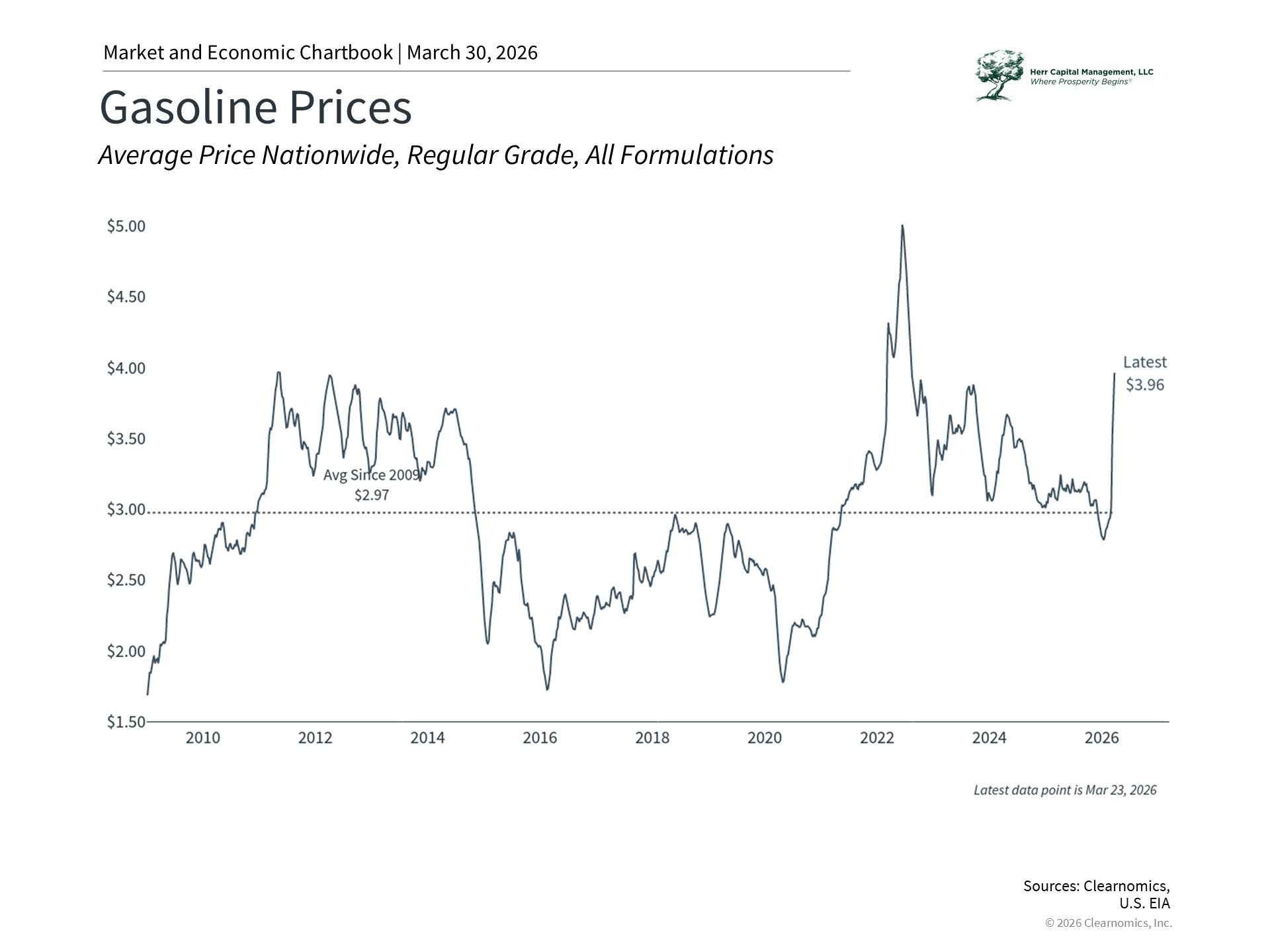 |
The national average for regular unleaded gasoline has climbed to around $4.00 per gallon, an increase of more than a dollar per gallon in just a month. While this is still below the record high of $5.00 per gallon reached in 2022, it could worsen if oil prices remain high. For most households, filling up the car is a non-negotiable cost. While they can try to drive slightly less, higher gasoline prices will directly impact discretionary spending and savings. Even with the adoption of electric vehicles, most cars on the road today still run on gasoline, meaning that higher prices at the pump affect nearly every household budget across the country.
The impact of higher gasoline prices on consumers is both direct and indirect. A simplified back-of-the-envelope calculation shows how this affects everyday consumer spending depending on income. If we suppose the average fill-up is 15 gallons, then the current increase adds $15 to each visit to the gas station. For those who fill up once a week, this amounts to roughly $780 less in their pockets per year.
At the federal minimum wage of $7.25 per hour, that would represent more than two additional hours of work just to stay financially afloat. The story is different for those at higher income ranges. The median American household earns just over $70,000 per year after taxes, according to the latest Census Bureau statistics, so this is above 1% of their after-tax income. While this leaves less money available for discretionary spending or savings, it can also likely be absorbed without causing significant financial difficulty.
So, higher gasoline prices effectively function as a direct tax on consumers. Without minimizing the challenges some may face due to these higher costs, it’s also clear that most households will be able to manage through this period.
From an investment standpoint, the drag on the economy can add up. When multiplied across millions of households filling up week after week, the cumulative impact on consumer spending and savings rates can be meaningful if oil prices stay higher for longer. However, it’s the indirect effects that are possibly more meaningful. Gasoline and diesel fuel are basic inputs into nearly everything the economy produces. Transportation, manufacturing, agriculture, and distribution all depend on energy, which means that higher fuel costs raise the price of goods and services across the board. This is why oil price spikes do not simply affect energy bills but can ripple across the economy over time.
Gasoline prices are not just about oil
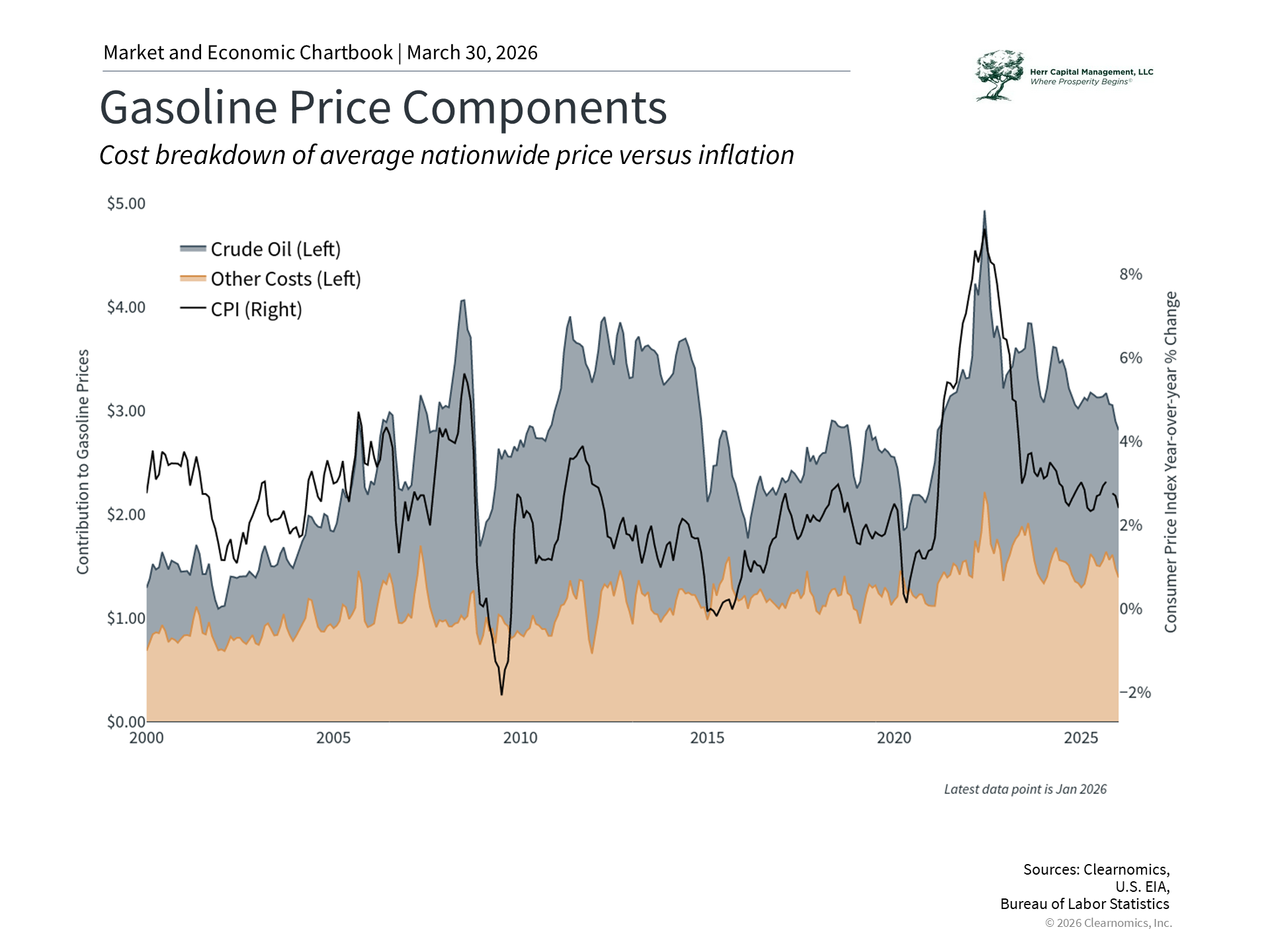 |
Understanding what drives gasoline prices can help put the current situation in perspective. According to the U.S. Energy Information Agency, roughly half of the price at the pump reflects the cost of crude oil itself. The other half consists of refining costs, transportation and distribution to gas stations, sales and marketing expenses, and federal and state taxes.
These costs are also why Americans in certain states pay considerably more than the national average for gasoline. The accompanying chart, based on the latest available data which does not yet show the latest jump in prices, illustrates how these components have shifted over time.
This relationship is partly why there is not a one-to-one relationship between oil prices and gas prices at the pump. This is also because it takes time for higher market prices, which adjust quickly in the futures market, to affect what consumers experience. The chart also shows the annual change in the overall Consumer Price Index and the clear relationship with oil prices over time.
For investors, it’s also important to note that the oil futures curve is deeply “backwardated” at the moment. This is a technical term meaning that oil prices are much higher today than they are expected to be in the future, a significant change from just a month ago when the curve was relatively flat. In other words, while current spot prices reflect the current Middle East supply disruption, traders are also signaling that they expect oil prices to eventually decline once conditions stabilize. This does not guarantee a quick resolution and can change as new information becomes available, but it does suggest that the market views the current spike as a one-time shock rather than a permanent shift to higher prices.
Higher energy prices complicate the inflation picture
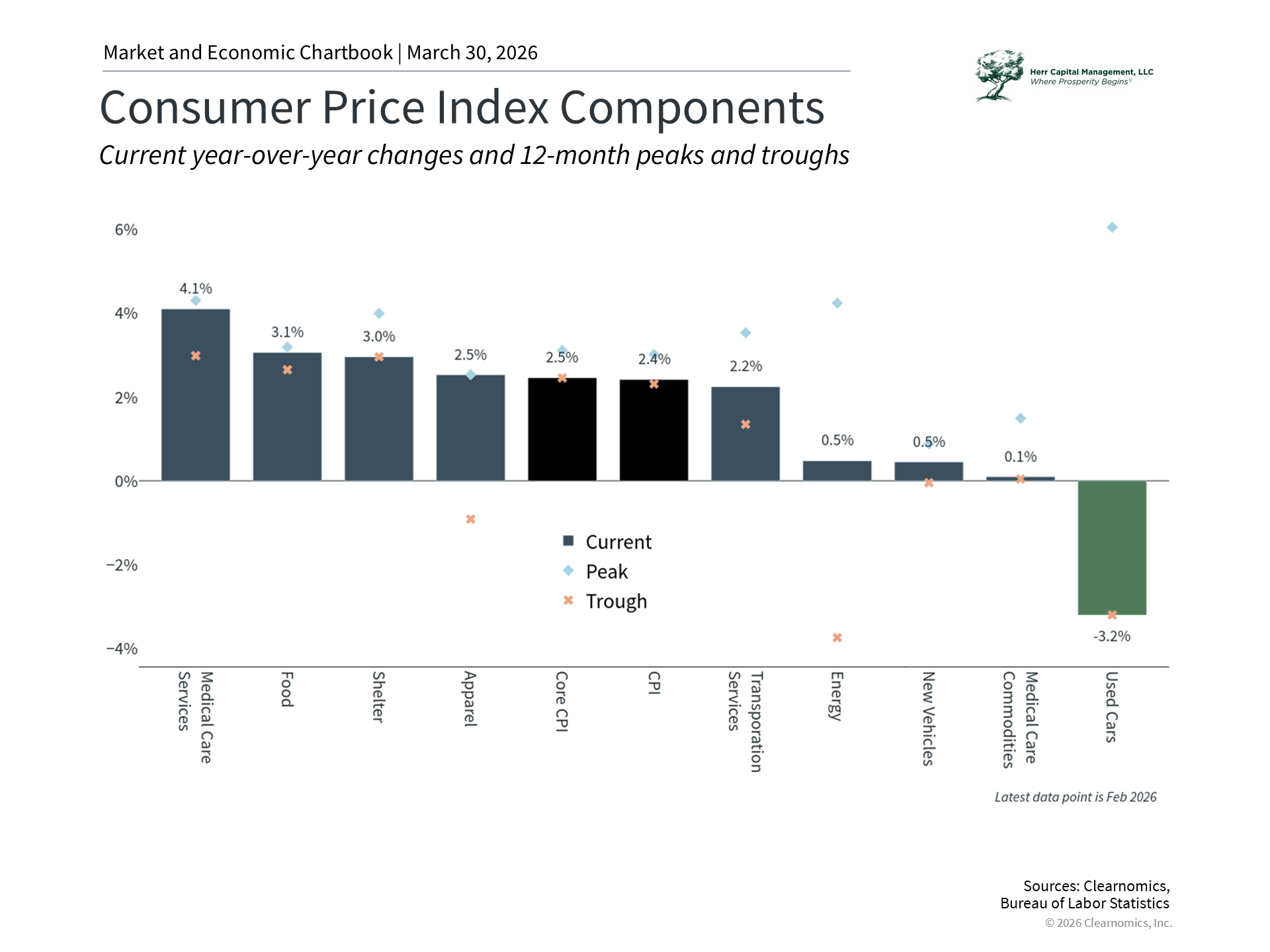 |
For investors, energy prices will impact headline inflation, since these costs are important components of the headline Consumer Price Index. After several years of improving energy CPI readings, the recent jump in oil and gasoline prices will almost certainly push headline inflation higher in the coming months. Organizations such as the OECD now estimate that U.S. inflation could rise faster than expected this year.
This matters for several reasons. First, consumers are still recovering from the inflation surge after the pandemic. Second, both stocks and bonds have historically faced headwinds when inflation rises unexpectedly, as it raises costs for companies and reduces the real value of fixed income payments. That said, markets have demonstrated considerable resilience over the past several years even in challenging inflationary environments.
Third, and perhaps most immediately relevant for financial markets, rising inflation complicates the Federal Reserve's decision-making. Markets have already shifted their expectations, with traders now assigning a greater probability to the Fed holding rates steady or even raising them rather than cutting. This reversal in expectations has introduced additional uncertainty for both equity and bond markets, especially as the Fed changes leadership in mid-May.
Economists generally view these types of “supply-side” shocks as temporary. This is not a prediction that high oil prices will be short-lived, per se, but instead focuses on the fact that high oil prices should fade once supply comes back online.
While the situation is still challenging for consumers, it is quite different from the 1970s. Specifically, the U.S. is the largest oil and natural gas producer, and the Fed has significantly more credibility in anchoring inflation expectations, making the current economic and financial market situation more stable than in the past. For investors, this means that the best approach continues to be staying invested with a well-constructed portfolio and financial plan. This served investors well during the last inflation spike in 2022, and is still likely the best way to achieve financial goals.
The bottom line? Rising gasoline prices are a burden for consumers and will likely drive headline inflation higher. However, history shows that markets and the economy have navigated past energy shocks. Investors should maintain a long-term perspective, avoid overreacting to daily headlines, and stay focused on their financial plans.
Herr Capital Management, LLC is a registered investment advisor domiciled in Illinois. This content is for information purposes and should not be construed as legal or tax advice and is not intended to replace the advice of a qualified attorney, financial or tax advisor or plan provider. Products or services mentioned on this Site will not be made available to persons resident in any state or territory where such distribution would be contrary to local law or regulation. Copyright (c) 2026 Clearnomics, Inc. All rights reserved. The information contained herein has been obtained from sources believed to be reliable, but is not necessarily complete and its accuracy cannot be guaranteed. No representation or warranty, express or implied, is made as to the fairness, accuracy, completeness, or correctness of the information and opinions contained herein. The views and the other information provided are subject to change without notice. All reports posted on or via www.clearnomics.com or any affiliated websites, applications, or services are issued without regard to the specific investment objectives, financial situation, or particular needs of any specific recipient and are not to be construed as a solicitation or an offer to buy or sell any securities or related financial instruments. Past performance is not necessarily a guide to future results. Company fundamentals and earnings may be mentioned occasionally, but should not be construed as a recommendation to buy, sell, or hold the company's stock. Predictions, forecasts, and estimates for any and all markets should not be construed as recommendations to buy, sell, or hold any security--including mutual funds, futures contracts, and exchange traded funds, or any similar instruments. The text, images, and other materials contained or displayed in this report are proprietary to Clearnomics, Inc. and constitute valuable intellectual property. All unauthorized reproduction or other use of material from Clearnomics, Inc. shall be deemed willful infringement(s) of this copyright and other proprietary and intellectual property rights, including but not limited to, rights of privacy. Clearnomics, Inc. expressly reserves all rights in connection with its intellectual property, including without limitation the right to block the transfer of its products and services and/or to track usage thereof, through electronic tracking technology, and all other lawful means, now known or hereafter devised. Clearnomics, Inc. reserves the right, without further notice, to pursue to the fullest extent allowed by the law any and all criminal and civil remedies for the violation of its rights.