


Inflation and Social Security COLA: Managing Purchasing Power
Terry Herr, CFP®
The annual Social Security cost-of-living adjustment (COLA) is one of the most important developments for retirees and consumers. Not only does it affect Social Security recipients directly since it determines the increase in benefits next year, but it also reflects the broader inflationary trends affecting all consumers and investors. This is especially important today as inflation continues to add pressure to many households.
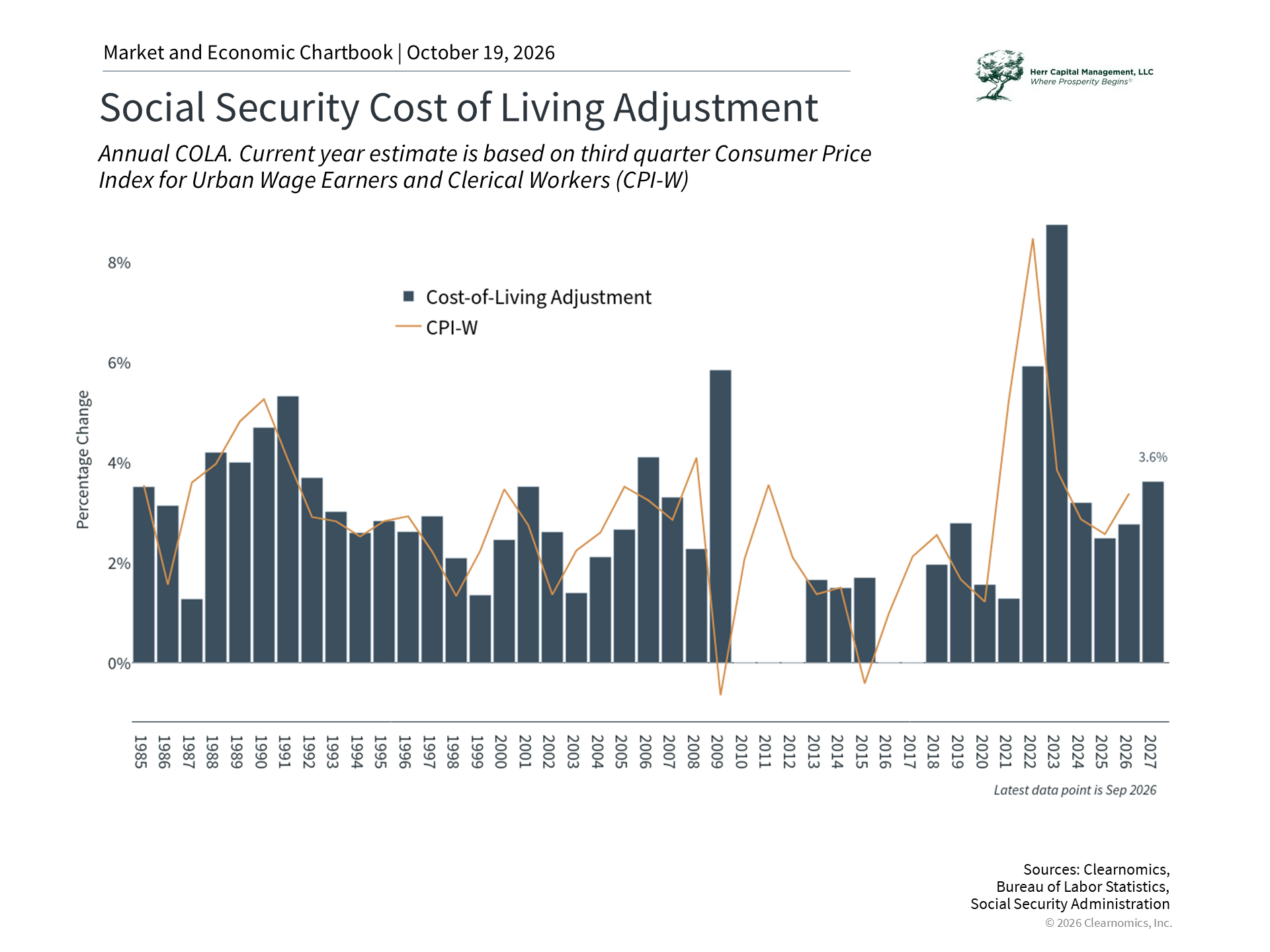
The Social Security Administration recently announced a 3.6% COLA for 2027, one of the highest in recent decades. While this is a healthy increase on paper, the reality is that this adjustment is one part of an overall strategy for maintaining purchasing power as prices rise. For long-term investors, it is important to understand what is driving inflation, what it means for cash yields, and how it affects portfolios.
The 2027 COLA reflects higher energy prices
 |
Inflation has faced two competing trends over the past year. Overall inflationary pressures from the pandemic period have been improving, with the Consumer Price Index decelerating from a peak of 9.1% year-over-year in 2022 to 2.7% at the start of 2026. However, rising energy prices due to the war in Iran have pushed inflation higher in recent months, with the latest CPI figure showing that prices have risen 3.7% over the past year.1 So, while the overall inflation trends have been positive, higher energy prices have raised costs for consumers more recently.
This is why the COLA adjustment for 2027 of 3.6% is the fifth-largest increase in over 35 years, and the highest since the 8.7% adjustment that took effect in 2023. To put this figure in historical context, it is also well above the 3.1% average COLA over the past decade.2
COLA is calculated using a version of the Consumer Price Index known as the CPI-W, which focuses on “urban wage earners and clerical workers.” This index compares price levels in the third quarter of the current year against the same period a year earlier. The challenge is that it’s difficult for one number to reflect the needs of all retirees. For example, the latest COLA figure means that the average Social Security recipient will see approximately $75 more per month beginning in January 2027.3 While this is positive, it may not be enough to fully offset inflation for many retirees due to rising costs for healthcare, prescription drugs, and other necessities.
By comparison, there is also an experimental measure known as CPI-E, or the Consumer Price Index for the Elderly. Its objective is to track households headed by adults aged 62 and older, and it has been proposed by some as a more appropriate benchmark of spending patterns among seniors. Since seniors spend a larger share of their income on inflation-sensitive areas such as healthcare and housing, CPI-E generally rises faster than CPI-W. For example, from January 1985 to January 2025, CPI-E rose 221% while the CPI-W increased 197%.4 That said, no single index can perfectly capture every household's experience.
For retirees enrolled in Medicare, it is also worth noting that the monthly Part B premium, which covers outpatient care, is projected to rise by $6.60 to $209.50.5 Since this amount is typically deducted from Social Security checks, it could partially offset the COLA increase for those affected. Part D prescription drug plan costs are also rising, and while lower-cost options remain available, these increases add another layer of complexity to the net benefit calculation. The actual increase in purchasing power for many retirees could be smaller than the headline percentage suggests.
Consumer spending is supporting broad economic growth
 |
When it comes to broader economic trends, inflation continues to impact many parts of the economy. Headline CPI rose 3.7% year-over-year in September, with gasoline prices accounting for more than half of the monthly increase with a surge of 9.1%. In contrast, core CPI, which excludes food and energy prices, rose only 2.6%.6
These figures suggest that the primary driver of today's inflation is still energy, rather than broad-based price pressures spreading across the entire economy. An even narrower measure of the Consumer Price Index, sometimes called “supercore” inflation since it excludes food, shelter, and energy, rose only 2.0%.7 Other inflation measures paint a similar picture.
It’s natural for higher inflation to hurt consumer sentiment, which has fallen to historic lows. Despite this, many measures of consumer spending continue to be strong. Retail sales, for example, showed a significant growth rate of 6.3% over the past year in September.8 However, this is also in part due to inflation, since gasoline accounted for approximately 71% of the monthly increase.
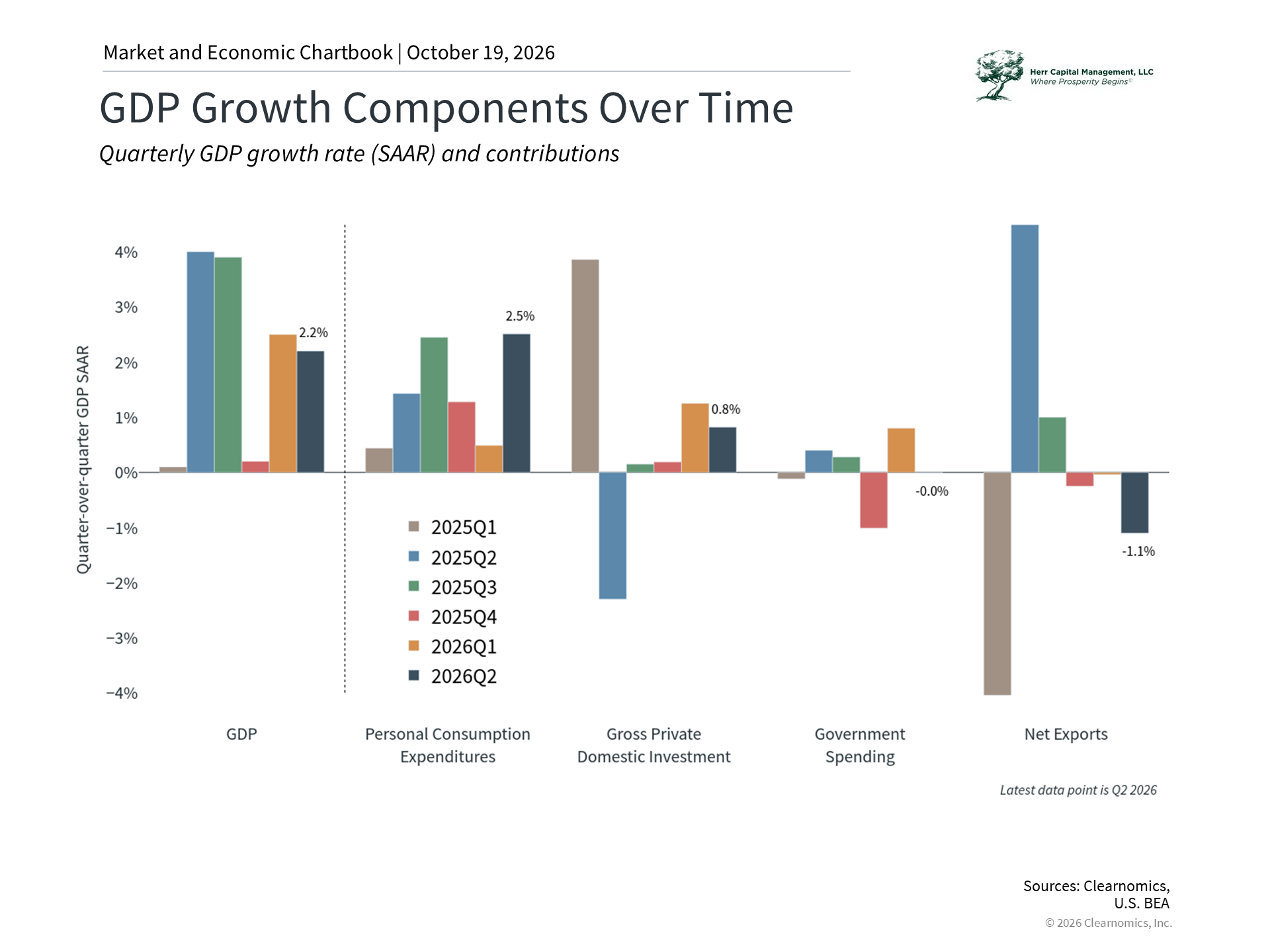
All of these factors influence real Gross Domestic Product (GDP) growth, which is calculated to exclude the effects of inflation. Despite higher inflation and uncertainty in the labor market, consumer spending has been strong, as shown in the chart above.9 Business investment has also remained steady, supported in part by ongoing AI-related capital spending on data centers and infrastructure. Together, these factors have helped to support broad economic growth, corporate profits, and financial markets, despite many ongoing challenges.
Cash yields are still lagging behind inflation
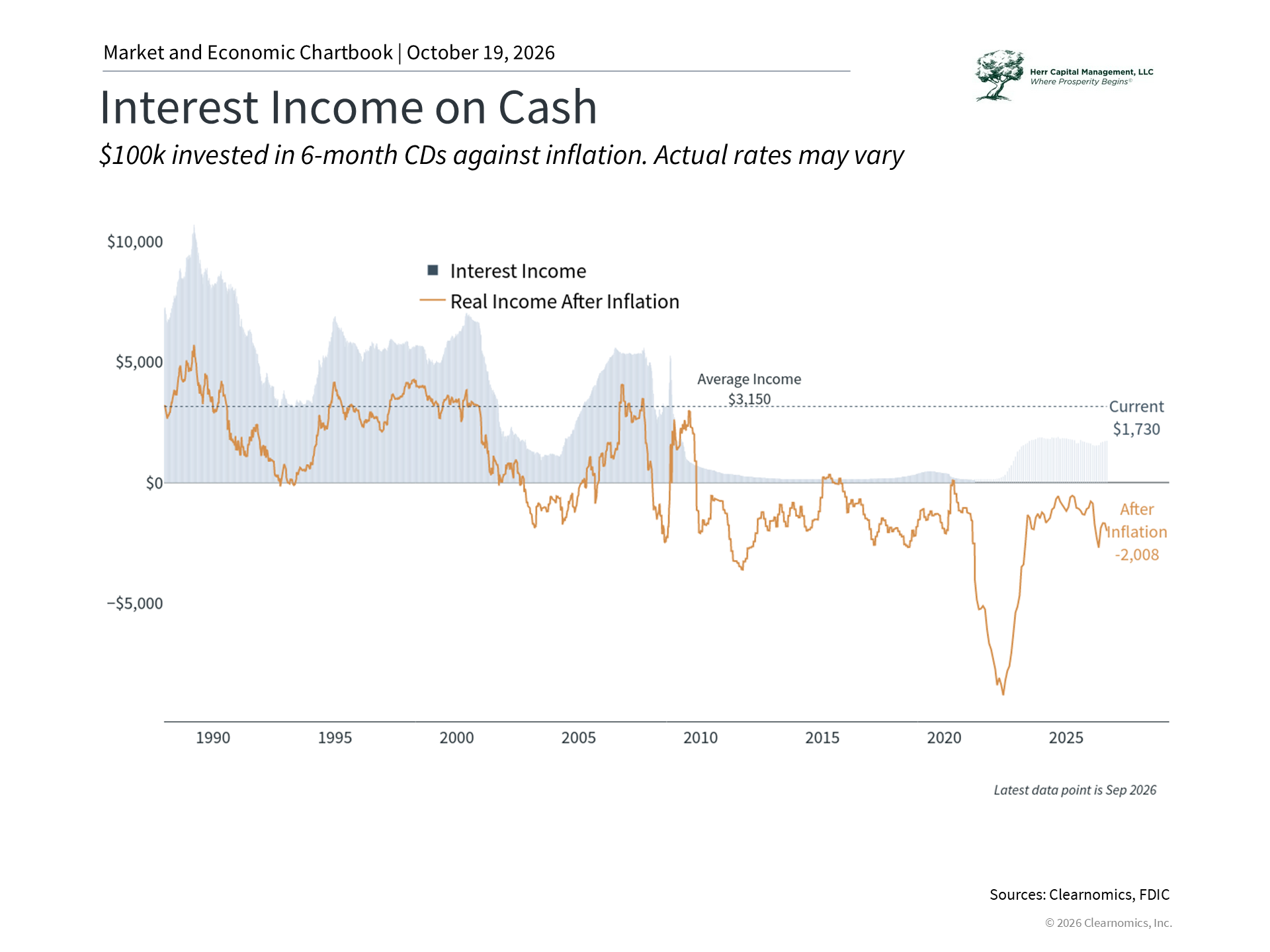 |
While economic growth continues to be stable, the combination of inflation and higher interest rates creates additional challenges for long-term investors. Even though nominal interest rates are elevated compared to much of the past decade, the inflation-adjusted yields on cash remain lower than many investors might expect, especially with the Fed raising policy rates.
For example, the chart above shows the interest income on cash, calculated using the average yields on six-month certificates of deposit, according to the FDIC. While these rates are higher than in the past, they are still not keeping pace with inflation. Of course, specific products and vehicles may have higher-than-average rates, but managing these products, ensuring that they are rolled over properly, and monitoring the overall rate environment are necessary. This means maintaining the purchasing power of savings continues to be a challenge, underscoring the importance of sticking to a long-term financial plan and holding a portfolio that can generate inflation-adjusted returns.
This is why, for many investors, looking beyond cash and annual benefits adjustments remains important for overcoming inflation. A balanced portfolio including allocations to stocks and bonds, when structured properly, can potentially offer more attractive real returns than cash alone. Investment-grade corporate bonds, for example, currently offer yields that are well above their long-run historical averages.
The bottom line? The 2027 Social Security COLA of 3.6% is a reminder that inflation remains a real challenge due to higher energy prices. Maintaining a balanced portfolio that doesn’t only rely on cash or benefit adjustments alone continues to be the best way to maintain and grow purchasing power.
HAVE QUESTIONS? CONTACT US.
References
- https://www.bls.gov/news.release/cpi.htm
- Clearnomics research using Social Security Administration data, as of October 18, 2026
- https://www.ssa.gov/news/en/press/releases/2026-10-14.html
- https://www.congress.gov/crs-product/IF12675
- https://www.cms.gov/oact/tr/2026
- https://www.bls.gov/news.release/cpi.htm
- https://www.bls.gov/news.release/cpi.htm
- Clearnomics research using U.S. Census Bureau data, as of October 18, 2026
- Clearnomics research using BEA data, as of October 18, 2026
Herr Capital Management, LLC is a registered investment advisor domiciled in Illinois.
This content is for information purposes and should not be construed as legal or tax advice and is not intended to replace the advice of a qualified attorney, financial or tax advisor or plan provider. Products or services mentioned on this Site will not be made available to persons resident in any state or territory where such distribution would be contrary to local law or regulation. Copyright (c) 2026 Clearnomics, Inc. All rights reserved. The information contained herein has been obtained from sources believed to be reliable, but is not necessarily complete and its accuracy cannot be guaranteed. No representation or warranty, express or implied, is made as to the fairness, accuracy, completeness, or correctness of the information and opinions contained herein. The views and the other information provided are subject to change without notice. All reports posted on or via www.clearnomics.com or any affiliated websites, applications, or services are issued without regard to the specific investment objectives, financial situation, or particular needs of any specific recipient and are not to be construed as a solicitation or an offer to buy or sell any securities or related financial instruments. Past performance is not necessarily a guide to future results. Company fundamentals and earnings may be mentioned occasionally, but should not be construed as a recommendation to buy, sell, or hold the company's stock. Predictions, forecasts, and estimates for any and all markets should not be construed as recommendations to buy, sell, or hold any security--including mutual funds, futures contracts, and exchange traded funds, or any similar instruments. The text, images, and other materials contained or displayed in this report are proprietary to Clearnomics, Inc. and constitute valuable intellectual property. All unauthorized reproduction or other use of material from Clearnomics, Inc. shall be deemed willful infringement(s) of this copyright and other proprietary and intellectual property rights, including but not limited to, rights of privacy. Clearnomics, Inc. expressly reserves all rights in connection with its intellectual property, including without limitation the right to block the transfer of its products and services and/or to track usage thereof, through electronic tracking technology, and all other lawful means, now known or hereafter devised. Clearnomics, Inc. reserves the right, without further notice, to pursue to the fullest extent allowed by the law any and all criminal and civil remedies for the violation of its rights.