


The View From 30,000 Feet: It's Easy to Forget How Far You've Climbed
Terry Herr, CFP®
A funny thing happens after you have been investing for a while. If you follow the market every day, every correction feels enormous. Every headline sounds urgent. Every decline feels like a personal setback. Yet if you zoom out and look at what you have actually accomplished over years or decades of investing, the picture often looks very different.
Consider a simple example. An investor who earns an average return of 7.2% per year will roughly double their money every 10 years using the Rule of 72. If you started with $500,000, ten years later you could have approximately $1 million.
Then the market drops 10%.
Suddenly, that investor sees their account fall from $1 million to $900,000 and feels like they are getting crushed.
But they are still up roughly $400,000 from where they started. They still have nearly twice the wealth they had a decade earlier. The recent loss is real, but it can overshadow years of progress if we are not careful.
That is why successful investing often requires perspective more than prediction.
The guide to Everest Base Camp often joked that "sometimes you have to go down to get up." The trail repeatedly descends hundreds of feet into valleys before climbing higher up the mountain. Investing works much the same way. Over the past 50 years, investors have endured countless declines caused by recessions, wars, political uncertainty, and market crashes, yet those temporary descents were often necessary stops along a much larger upward journey.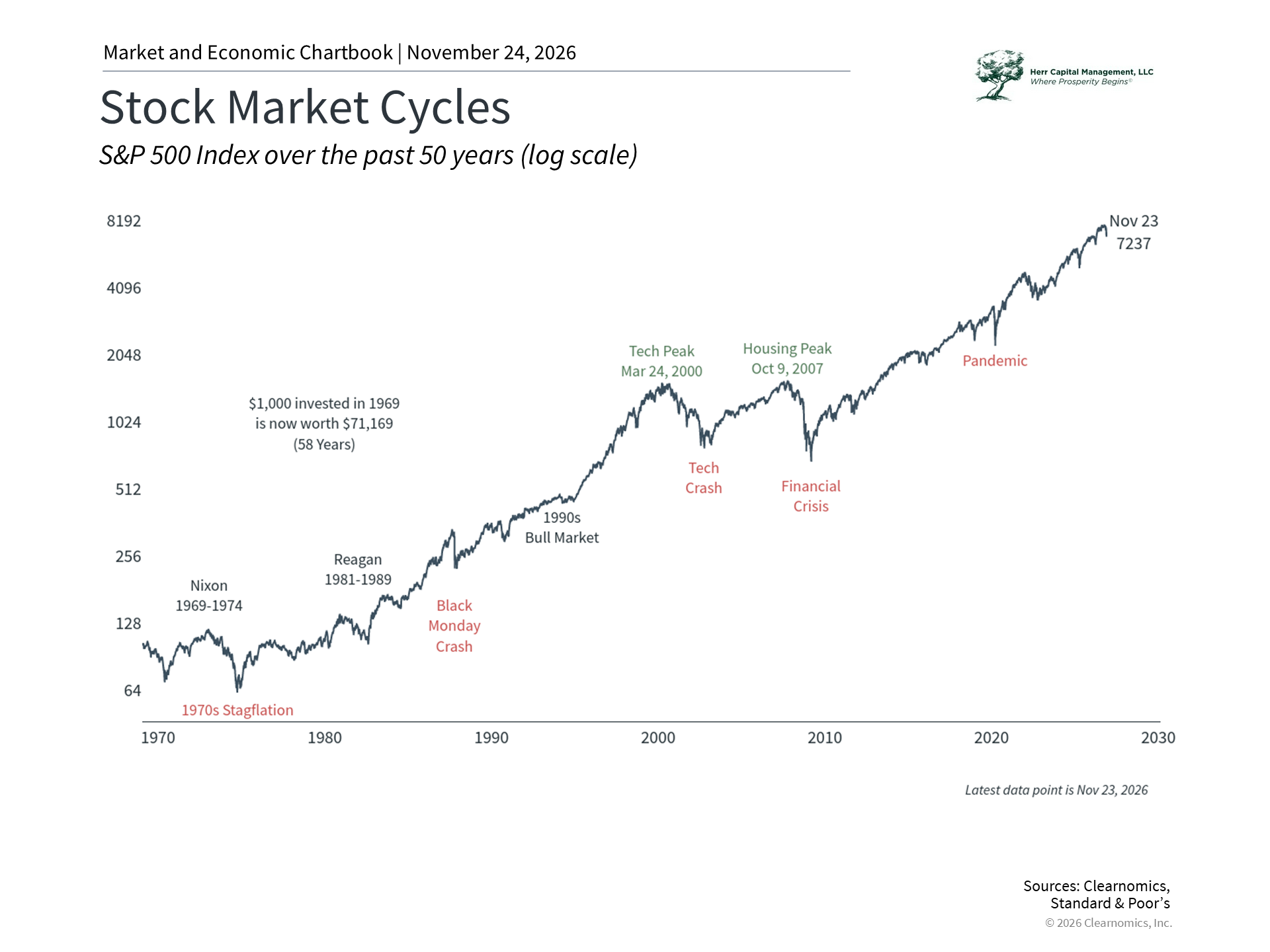
The Cost of Long-Term Success
Investors often want two things that cannot coexist:
- Stock market returns.
- Freedom from stock market volatility.
Unfortunately, the return is the reward for enduring the volatility.
Every market decline feels different when you are living through it. Headlines create urgency. Emotions encourage action. Yet temporary declines are not evidence that a long-term plan is broken. They are the price investors pay for the opportunity to earn long-term growth.
A Different Scorecard
When markets decline, it is natural to focus on what has been lost recently. successful investing is rarely about the last week, month, or quarter. It is about decades of steady progress.
If your wealth has doubled over the last decade, a correction may be frustrating, but it does not erase the accomplishment.
The investor who remains focused on long-term objectives often finds that today's “crisis” becomes a barely visible blip on tomorrow's chart.
The market will always give us reasons to worry in the short term. The real question is whether we are measuring success by the last 10 days or the last 10 years.
Because when you step back far enough, the view often looks much better than the headlines suggest.
This article is provided for informational and educational purposes only and should not be construed as personalized investment, tax, legal, or financial planning advice. The views expressed are based on current market conditions and are subject to change without notice. Past performance is not indicative of future results, and all investing involves risk, including the possible loss of principal. Examples and hypothetical illustrations, including references to investment returns and the Rule of 72, are intended solely to demonstrate general investment concepts and do not represent the performance of any specific investment, account, or client experience. Diversification and asset allocation strategies do not guarantee a profit or protect against loss in declining markets. Investors should carefully consider their individual objectives, risk tolerance, time horizon, and financial circumstances before making investment decisions. Any references to specific securities, sectors, or investments are for illustrative purposes only and should not be considered a recommendation to buy, sell, or hold any security. Please consult your financial advisor, tax professional, and legal counsel regarding your specific situation before implementing any investment strategy.
Herr Capital Management, LLC is a Registered Investment Adviser. Registration as an investment adviser does not imply any level of skill or training. Additional information about Herr Capital Management, including its services, fees, and conflicts of interest, is available in the firm's Form ADV, which is available upon request.