


Holidays and Year-End Planning: Strategies to Achieve Your Financial Goal
Melissa N. Osika, MBA
The upcoming holiday period is often filled with gatherings, travel, and family traditions. It is also a natural time to reflect on the long-term goals that matter most and the financial decisions that can help support them. From finalizing year-end tax strategies to strengthening retirement savings and supporting charitable causes, there are steps worth considering before the calendar turns.
With year-end approaching, these actions can make a real difference in your financial picture. Whether you are looking to reduce your tax burden, maximize contributions to retirement accounts, or make a lasting impact through charitable donations, thoughtful planning now can help set a strong foundation for the year ahead. It is worth noting that some of these opportunities carry a December 31 deadline, so it’s important to start now.
In this discussion, we highlight several year-end strategies for investors to consider, including charitable giving, retirement planning, and positioning portfolios for tax efficiency. These topics can be complex and there are many rules that affect different individuals in unique ways, so it’s always important to seek professional advice.
Roth conversions and tax-loss harvesting can be impactful during market swings
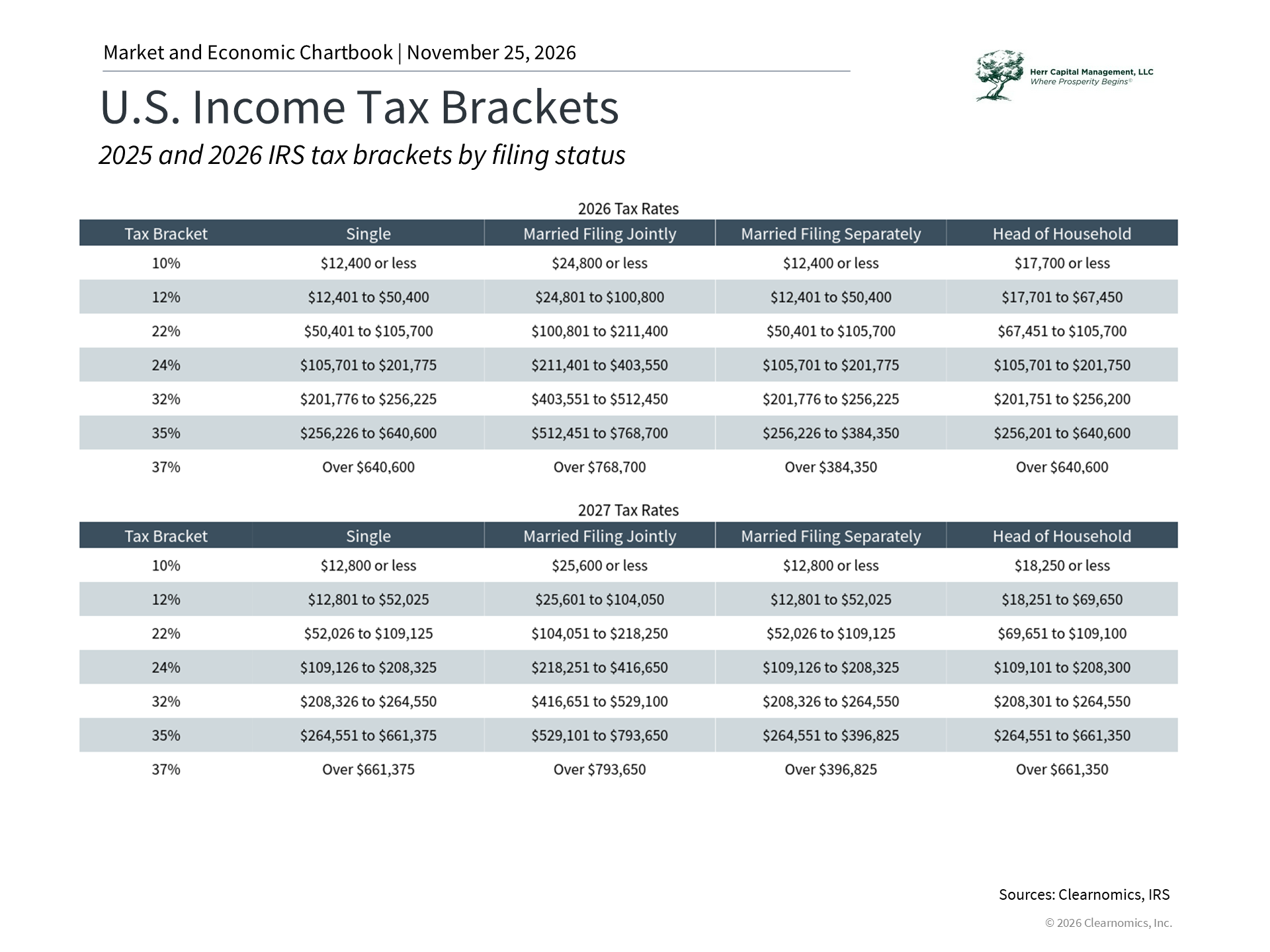 |
Two strategies that investors may find relevant at this time of year are tax-loss harvesting and Roth conversions. While they serve different purposes, both can help enhance a broader financial plan. This is especially relevant amid the recent market volatility, which can create a window for investors to harvest unrealized losses in taxable accounts to lower the current year’s tax bill, or to convert temporarily undervalued assets into a Roth IRA.
For investors facing a capital gain this year, tax-loss harvesting can be a way to lower tax obligations by selling investments that have declined in value to offset capital gains. For example, an investor who is set to realize $10,000 in capital gains could sell a different investment at a $4,000 loss, reducing the net taxable capital gains to $6,000. Of course, taxes are rarely the primary reason to sell an investment, but harvesting losses can add value in certain circumstances.
An important consideration when selling undervalued assets is the “wash sale” rule, which prevents an investor from purchasing the same or a “substantially identical” security within 30 days before or after the sale.1 They can, however, replace positions with similar investments such as an exchange traded fund (ETF), allowing them to maintain market exposure and their desired asset allocation while still harvesting the tax loss.
Moving investments from one account to another can trigger a taxable event, depending on the account type. For example, Roth conversions involve transferring assets from a traditional IRA to a Roth IRA, creating a taxable event now in exchange for tax-free growth and distributions later. Converting after a market decline can be particularly attractive because the tax is based on the value of the assets at the time of conversion. This means that a temporary pullback can act like a “discount” on the tax that would otherwise be owed at the investor’s marginal rate, while any rebound occurs inside the Roth account.
This strategy may be beneficial for investors who are currently in a lower tax bracket than they expect to be in during retirement, as well as for those who are experiencing a low-income year, such as commission-based earners, those with family commitments, or those on a career break.
How the One Big Beautiful Bill Act changes charitable giving strategies
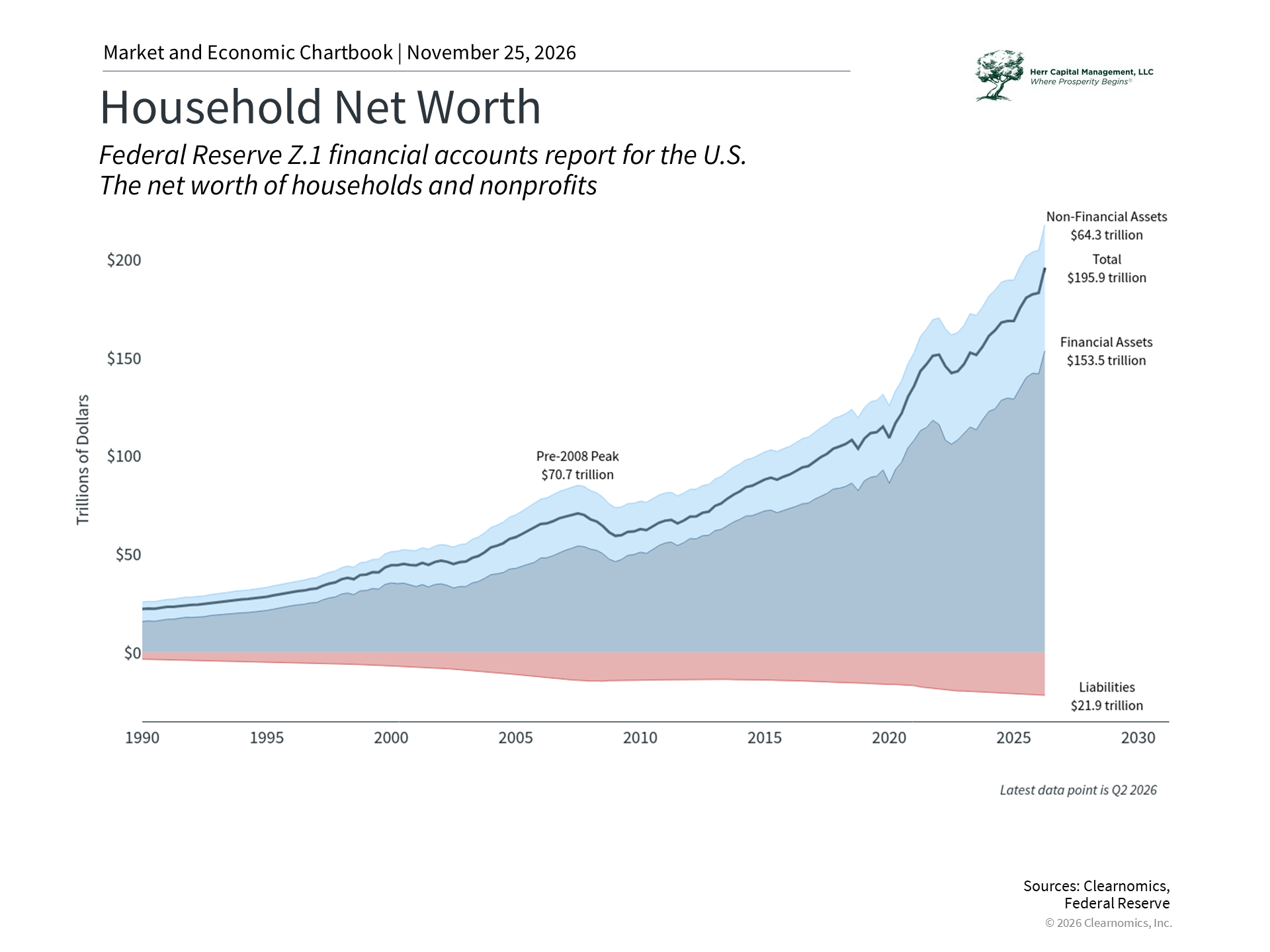 |
Household net worth has increased steadily as the economy, stock market, and housing have grown over the years. According to the Federal Reserve, the net worth of households exceeded $195 trillion in the second quarter of 2026.2 For some families, greater wealth may create opportunities to support charitable causes as part of their broader financial plans, and the holiday season can be a wonderful time to do so.
Americans gave an estimated $617 billion to charity in 2025, a 5.7% increase from 2024, and surpassing the $600 billion mark for the first time, according to Giving USA, the longest-running annual report on charitable giving.3 That record-setting generosity came just before major tax law changes affected how giving is rewarded. Specifically, the One Big Beautiful Bill Act (OBBBA), passed in 2025, introduced two significant changes to charitable deductions that took effect in 2026. These changes affect taxpayers differently depending on whether they take the standard deduction or itemize.
For those who used the standard deduction in the past when filing their annual taxes, charitable contributions were previously not allowed, so for many taxpayers there was often no tax benefit. However, the new provision allows deductions of up to $1,000 in qualifying cash contributions, or $2,000 for married couples filing jointly.4
For taxpayers who itemize deductions, charitable contributions are still eligible but now have to exceed 0.5% of adjusted gross income, or AGI.5 For example, a person with $200,000 in AGI would have a $1,000 floor, meaning that donations must be above that $1,000 threshold to be deductible. For itemizers, the “bunching” strategy, or combining multiple years of charitable gifts into a single tax year, becomes more relevant as it can help exceed the charitable deduction threshold. Donors may then take the standard deduction in future years when they expect to make smaller charitable contributions.
Rather than donating cash, some investors may benefit from giving appreciated securities. Gifting highly appreciated securities held for more than one year offers three key tax benefits. Specifically, it avoids capital gains tax from an outright sale, removes further appreciation from the gross estate, and provides a deduction on ordinary income. This "triple benefit" can be especially attractive during years with significant capital gains, such as when equity compensation vests or following a business sale, and when there are no losses to offset the gain.
Managing retirement distributions during periods of volatility
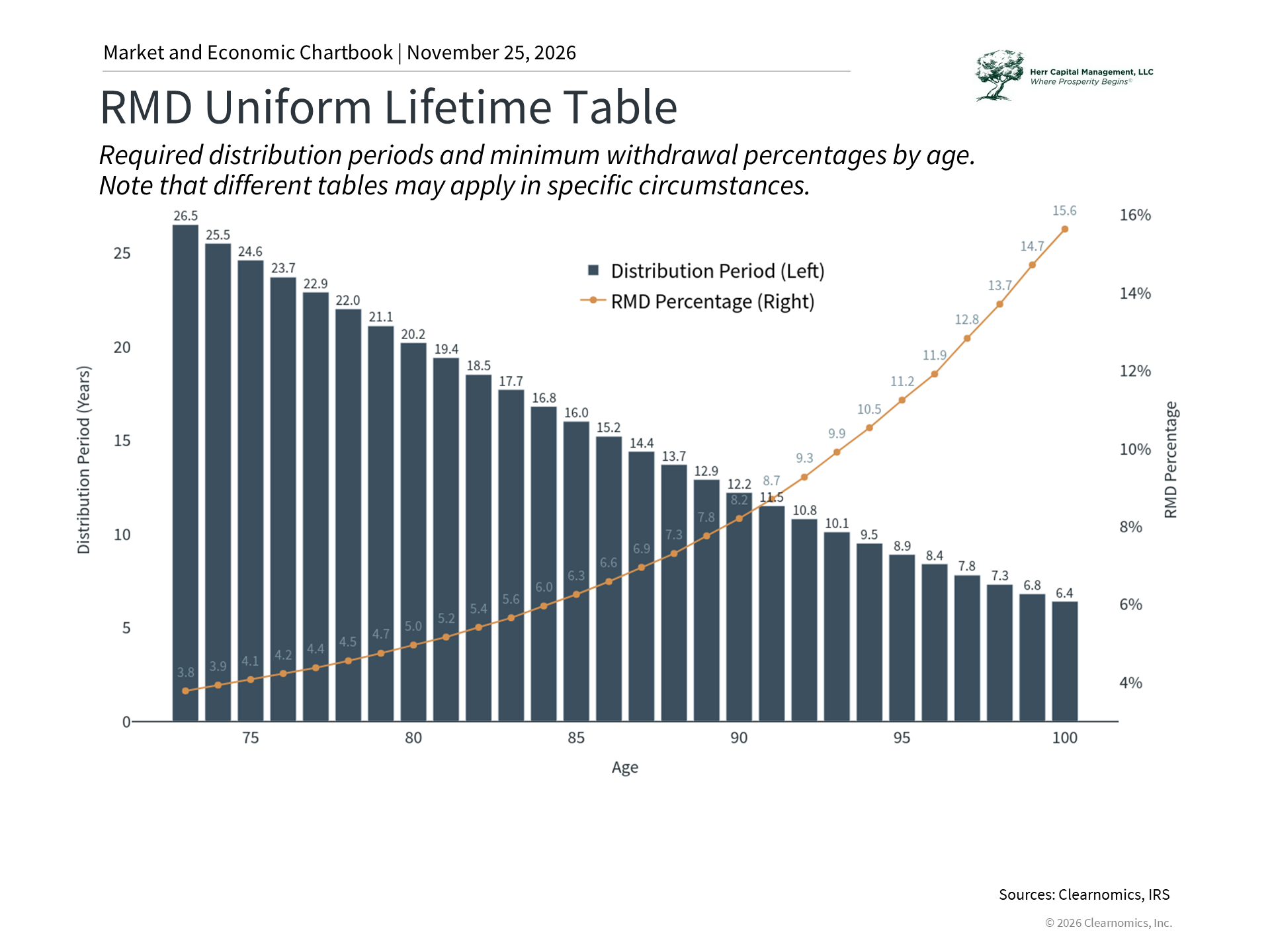 |
The end of the year is also an important time for investors who are required to take distributions from their retirement accounts. Required minimum distributions (RMDs) are the minimum amounts that must be withdrawn each year from traditional IRAs, 401(k)s, and other applicable tax-deferred retirement accounts once an individual reaches age 73 (for those who turned 72 after December 31, 2022) and increases further to 75 in 2033.6
Annual RMDs after the first year must be taken by December 31. Missing a required distribution can result in an excise tax of 25% of the amount not withdrawn, reduced to 10% if the shortfall is corrected within 2 years.7 An RMD is calculated by taking the retirement account’s balance at the end of the previous year and dividing it by the life expectancy factor using the IRS Uniform Lifetime Table.8 This is an important point as it means that the required withdrawal does not decline automatically if the account loses value during the current year.
For those with a capacity and desire to give large amounts to charity, a qualified charitable distribution (QCD) allows a distribution up to $111,000 per individual (for 2026) from an eligible IRA to a qualifying charity for those aged 70½ or older.9 Not only does this satisfy the RMD while excluding the distributed amount from taxable income, but it is also a great way to connect retirement planning with charitable giving goals.
As the year-end approaches, reviewing charitable gifts, retirement account distributions, and portfolio decisions can help investors prepare for the year ahead. Considering how these strategies work together can also help ensure that near-term decisions support longer-term financial goals. Working with a trusted advisor can help investors determine which strategies are appropriate for their individual circumstances.
The bottom line? While financial planning is a year-round activity, many tax-related decisions have calendar-year deadlines, and periods of market volatility often make them even more valuable. Reviewing a financial plan before 2026 closes helps investors step into the new year knowing their portfolios are aligned with their long-term financial goals, leaving more time to enjoy the holidays with family and friends.
References
- https://www.irs.gov/pub/irs-pdf/i1040sd.pdf
- https://www.federalreserve.gov/releases/z1/
- https://givingusa.org/giving-usa-charitable-giving-rose-to-617-20-billion-in-2025-surpassing-the-600-billion-mark-for-the-first-time/
- https://www.irs.gov/taxtopics/tc506
- https://www.congress.gov/crs-product/R48789
- https://www.irs.gov/retirement-plans/retirement-plan-and-ira-required-minimum-distributions-faqs
- https://www.irs.gov/retirement-plans/plan-participant-employee/retirement-topics-required-minimum-distributions-rmds
- https://www.irs.gov/publications/p590b#en_US_2025_publink100090310
- https://www.congress.gov/crs-product/IF11377
Herr Capital Management, LLC is a registered investment advisor domiciled in Illinois.
This content is for information purposes and should not be construed as legal or tax advice and is not intended to replace the advice of a qualified attorney, financial or tax advisor or plan provider. Products or services mentioned on this Site will not be made available to persons resident in any state or territory where such distribution would be contrary to local law or regulation. Copyright (c) 2026 Clearnomics, Inc. All rights reserved. The information contained herein has been obtained from sources believed to be reliable, but is not necessarily complete and its accuracy cannot be guaranteed. No representation or warranty, express or implied, is made as to the fairness, accuracy, completeness, or correctness of the information and opinions contained herein. The views and the other information provided are subject to change without notice. All reports posted on or via www.clearnomics.com or any affiliated websites, applications, or services are issued without regard to the specific investment objectives, financial situation, or particular needs of any specific recipient and are not to be construed as a solicitation or an offer to buy or sell any securities or related financial instruments. Past performance is not necessarily a guide to future results. Company fundamentals and earnings may be mentioned occasionally, but should not be construed as a recommendation to buy, sell, or hold the company's stock. Predictions, forecasts, and estimates for any and all markets should not be construed as recommendations to buy, sell, or hold any security--including mutual funds, futures contracts, and exchange traded funds, or any similar instruments. The text, images, and other materials contained or displayed in this report are proprietary to Clearnomics, Inc. and constitute valuable intellectual property. All unauthorized reproduction or other use of material from Clearnomics, Inc. shall be deemed willful infringement(s) of this copyright and other proprietary and intellectual property rights, including but not limited to, rights of privacy. Clearnomics, Inc. expressly reserves all rights in connection with its intellectual property, including without limitation the right to block the transfer of its products and services and/or to track usage thereof, through electronic tracking technology, and all other lawful means, now known or hereafter devised. Clearnomics, Inc. reserves the right, without further notice, to pursue to the fullest extent allowed by the law any and all criminal and civil remedies for the violation of its rights.