


Mid-Year Outlook 2026: Key Investor Lessons for the Second Half of the Year
Herr Capital Management, LLC - 2026 Second Quarter Market Commentary
Mid-Year Outlook 2026: Key Investor Lessons for the Second Half of the Year
There is a saying that smooth seas do not make skillful sailors. When it comes to investing, at no time has this been more true than during the first half of the year. Investors faced major events including the war in Iran, oil prices pushing inflation to multi-year highs, and questions around artificial intelligence (AI). And yet, markets have climbed to new all-time highs, corporate earnings have grown at a double-digit pace, and many asset classes have performed well. The first six months have been a reminder of the importance of staying invested and maintaining a longer time horizon.
This lesson is perhaps even more important today because the business cycle is now in its seventh year while the market cycle is approaching its fifth. For investors, it can feel as if the same set of concerns have cycled in and out of focus, including inflation, the Fed, valuations, and more. Managing these conflicting challenges is not just a part of investing, but is why investors who stay the course are rewarded in the long run.
There will no doubt be unexpected events in the second half of the year, including developments in the ongoing Middle East conflict, the upcoming midterm election, and new market activity such as initial public offerings (IPOs). How can investors maintain perspective as these events unfold?
Key Market and Economic Drivers in the First Half of 20261
- The S&P 500, Nasdaq, and Dow Jones Industrial Average have returned 9.6%, 12.8%, and 8.9% year-to-date through the end of June, respectively. The second quarter was historically strong with the S&P 500 returning 14.9%, the Nasdaq 21.4%, and the Dow 12.9%.
- The Bloomberg U.S. Aggregate Bond Index has risen 0.6% year-to-date. The 10-year Treasury yield ended the second quarter at 4.47%, rising from 4.17% at the start of the year.
- Developed market international stocks (MSCI EAFE) have gained 7.7% and emerging market stocks (MSCI EM) have returned 22.7% year-to-date, both in U.S. dollar terms.
- The Bloomberg Commodities Index has risen 12.3% year-to-date. This was due to a strong first quarter which experienced a gain of 23.3%, versus a decline of 8.9% in the second quarter.
- Brent crude peaked just under $120 per barrel in May before closing the quarter at $73 per barrel.
- Gold prices fell to $4,007 per ounce while Bitcoin declined to a recent low of $58,633.
- Headline CPI rose 4.2% year-over-year in May, driven largely by energy prices. Core CPI, which excludes food and energy, rose 2.9%.
- The Federal Reserve kept rates unchanged at 3.50% to 3.75% through the first half of the year. Kevin Warsh was sworn in as Fed Chair in May.
The business cycle has entered its seventh year
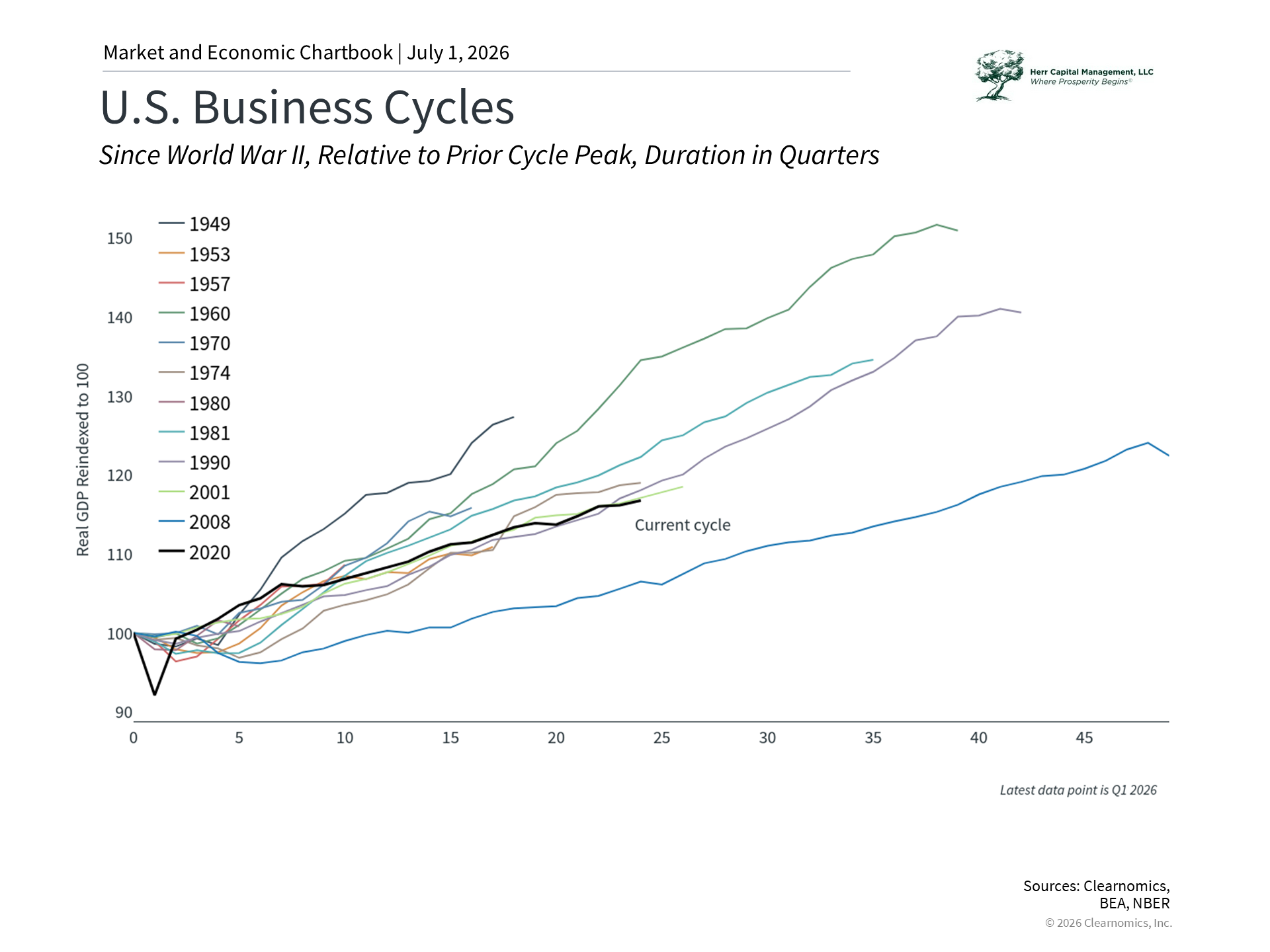 |
It may be surprising to some investors that the current business cycle began in April 2020 amid the pandemic and just passed its sixth anniversary in the second quarter. There have been several times when investors and economists worried that there might be another recession, including when inflation peaked in 2022 and when tariffs disrupted trade last year. Through it all, the economy has been resilient, growing steadily despite these challenges.
The business cycle affects all aspects of investing and financial planning, from mortgage costs to annual pay raises. A healthy economy drives consumer spending and business investment, fueling corporate earnings and ultimately stock market returns. So, while the stock market and economy are not the same thing, they are often closely linked. The chart above compares this cycle to other historical periods. The longest business cycles, including the one that began after the 2008 financial crisis and the 1990s during the dot-com boom, have lasted for a decade or longer.
How is the economy doing today? Inflation is high but could improve if oil prices remain low. The job market has begun to heat up again, reversing last year’s concerns over the slow pace of hiring. The dollar has stabilized and rebounded more recently, trade is still uncertain but has stabilized, and business investment has accelerated. Consumers are feeling pessimistic, but continue to spend on both necessities and discretionary items. Overall, the economy appears to be healthy despite some mixed signals, which is historically positive for financial markets in the long run.
Many asset classes have performed well this year
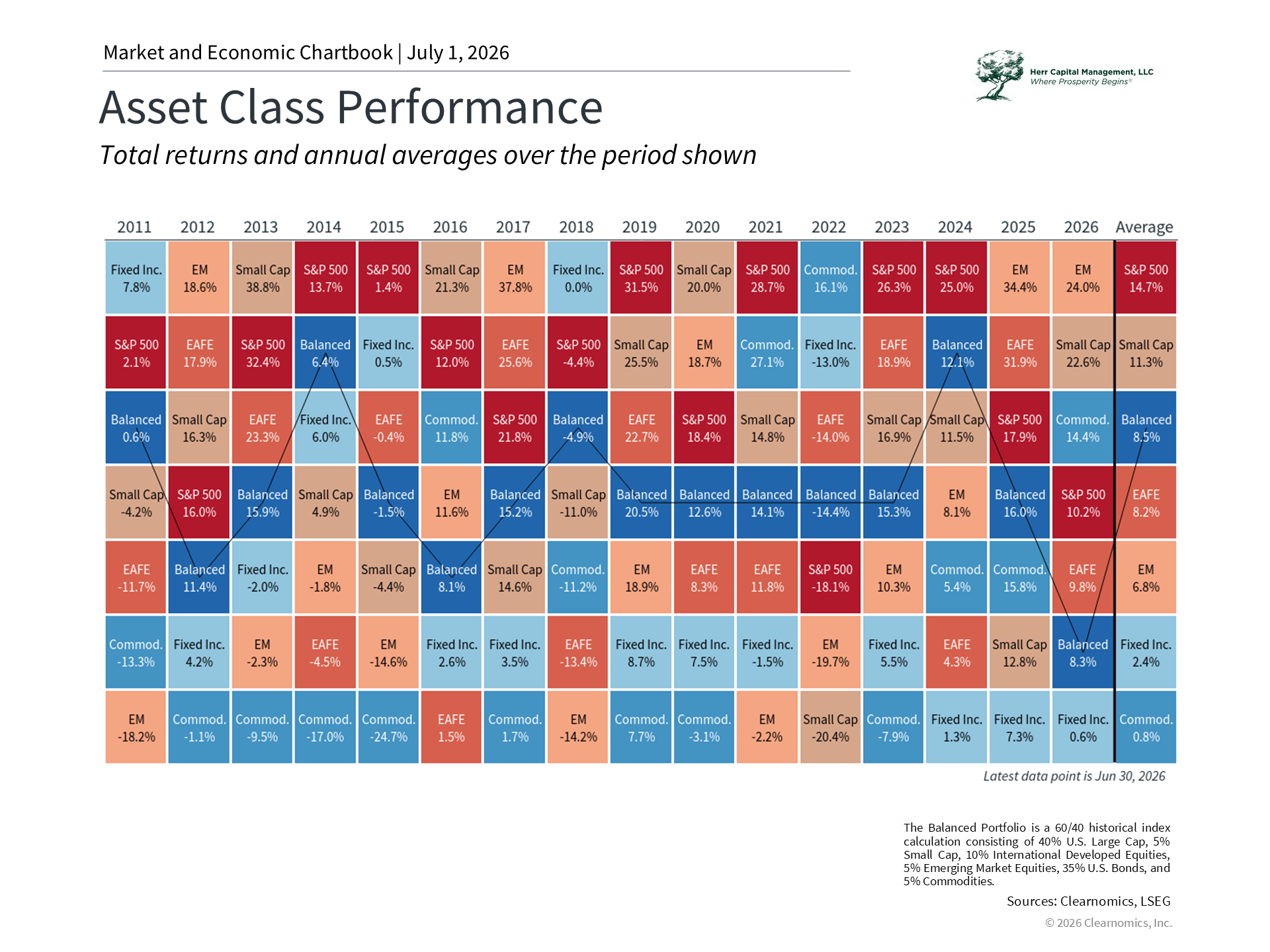 |
A variety of global asset classes have contributed to portfolios so far this year, continuing last year’s trend. This includes not only large cap stocks, represented by the S&P 500, but also small caps, emerging markets, and commodities, as shown in the chart above. The second quarter, in particular, was one of the strongest on record. This is partly due to the timing of the war in Iran which resulted in the market recovery beginning at the start of April.
There are many themes behind these returns, including the strength of the economy, hopes of a peace deal in Iran, and enthusiasm around AI. Many of these factors have driven corporate earnings growth, with profits rising over 20% in the past twelve months for S&P 500 companies.2 This strong market environment has also led to a wave of high-profile IPOs, including SpaceX in the second quarter, and the anticipated listings of OpenAI and Anthropic, both AI companies.
While investors often focus on the first few days of an IPO when there are the most headlines, the real benefits accrue over a longer period. The benefit of these listings is that they broaden the opportunity set for all investors, which is especially important since many companies have been staying private longer. What matters most is how these businesses then perform over the years and decades that follow. The largest technology companies today, for instance, have grown over a long period through many market and economic cycles.
All of these positive trends do mean that U.S. stock valuations are historically high. The S&P 500 currently trades at a price-to-earnings ratio of 20x, above the long-term historical average of 16x.3 These valuation ratios do not predict what the markets will do over the next year or two. Instead, they are helpful guides for building long-term portfolios, especially when considering other asset classes and risk management. Overall, this year’s asset class returns show the importance of maintaining balance.
Inflation remains a concern but oil prices have improved
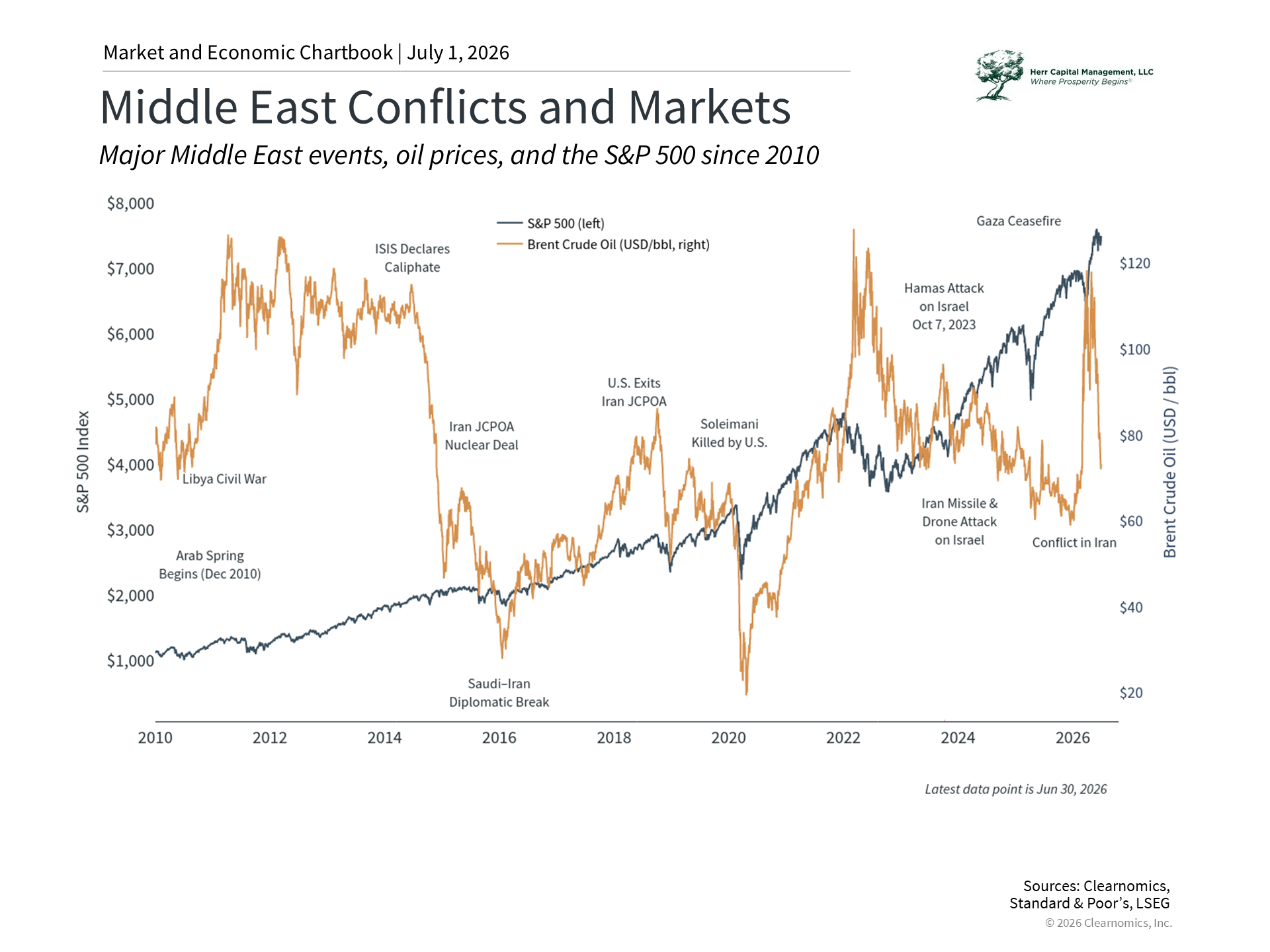 |
The ups and downs of the conflict in Iran have primarily affected the U.S. economy through energy markets. Disruptions to oil transportation through the Strait of Hormuz pushed Brent crude to nearly $120 per barrel before prices pulled back significantly. In recent weeks, oil prices have fallen to around $70, near pre-conflict levels. Gasoline prices have followed a similar path on a delayed basis, peaking above $4.50 per gallon nationally before retreating below $4.00 per gallon more recently.4
Energy price swings have directly impacted inflation rates. The Consumer Price Index rose 4.2% year-over-year in May, its highest reading in several years, with the gasoline component jumping 40.5% over the same period. Importantly, core CPI, which excludes food and energy, rose only 2.9%.5 This shows that inflation has been concentrated in fuel prices, and is not yet a broader phenomenon.
With oil prices falling recently, many economists hope that we are near peak inflation levels. This is similar to other past geopolitical shocks that affected the supply of oil, such as Russia's invasion of Ukraine in 2022, and many others shown in the chart above. Once the situation stabilized, oil prices often improved, bringing inflation rates back down over time.
Volatility has been manageable
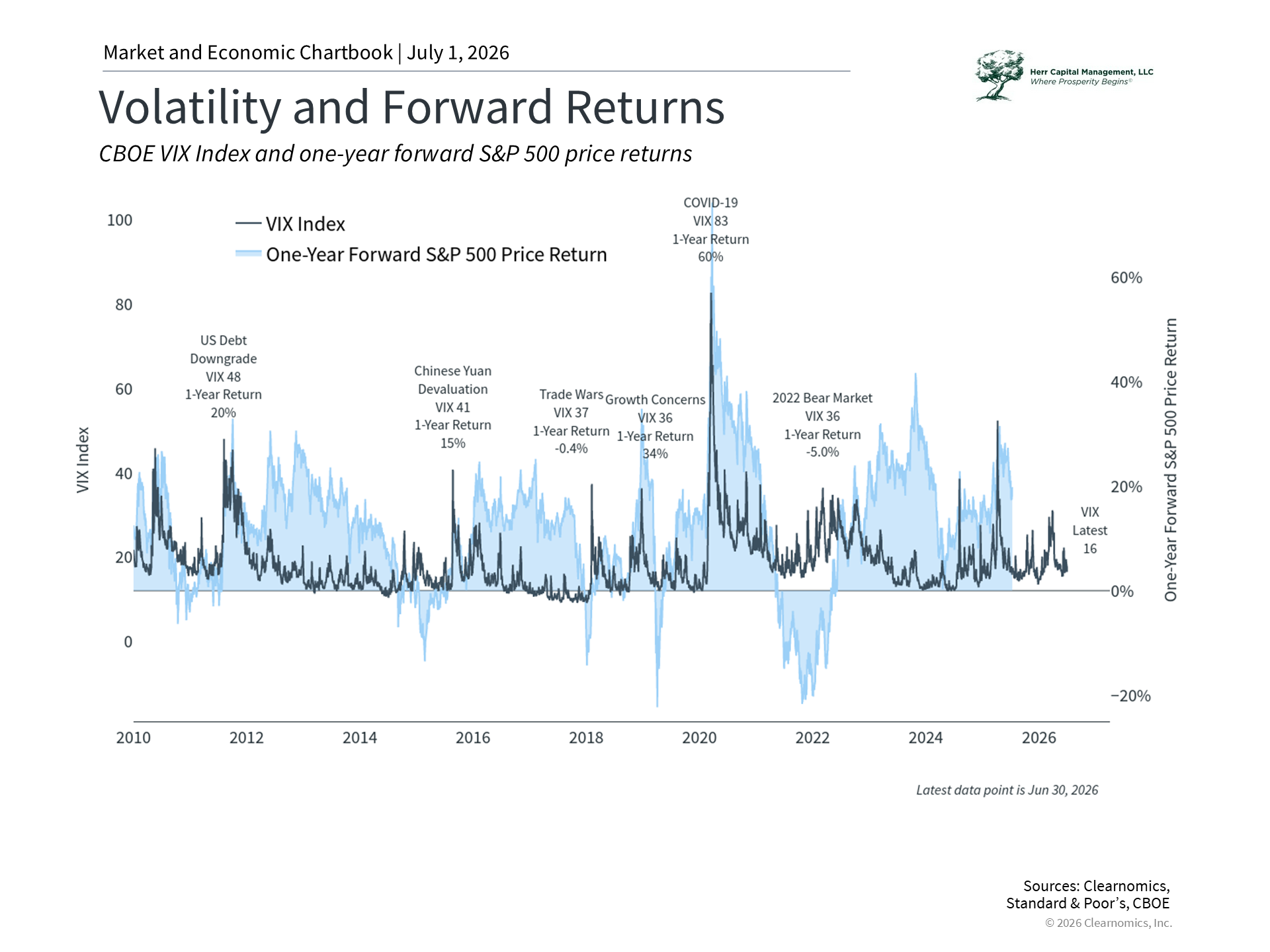 |
Investors have grown accustomed to brief periods of volatility caused by macroeconomic events. Between tariffs, the Middle East conflict, and uncertainty around the Fed, these events have led to short-lived market swings in just the past year alone. This can be seen in the VIX index, a common measure of stock market volatility. Fortunately, the current VIX reading of 16 sits below its long-term average of 18.4, and is well below recent peaks. This is shown in the chart above and also demonstrates that periods of volatility are also when the market opportunity can be the greatest.
Another way to think about how these market moves affect investors is via the largest pullback each year. So far, the S&P 500's largest peak-to-trough decline in 2026 has been 9%. While pullbacks like these are never pleasant, markets tend to rebound when investors least expect it. Today, not only has the market fully recovered from its earlier pullback, but the S&P 500 has reached 24 new all-time highs so far this year.6
The first half of the year demonstrates that the most important risk for investors navigating these episodes is not the volatility itself, but how we react to them. It’s tempting to try to time the market during periods of uncertainty, but this can often backfire. Instead, it’s better to hold a portfolio that is designed to withstand all parts of the market cycle, while serving long-term financial goals. By doing so, investors can better prepare for the inevitable periods of uncertainty in the second half of the year.
It’s important to stay invested
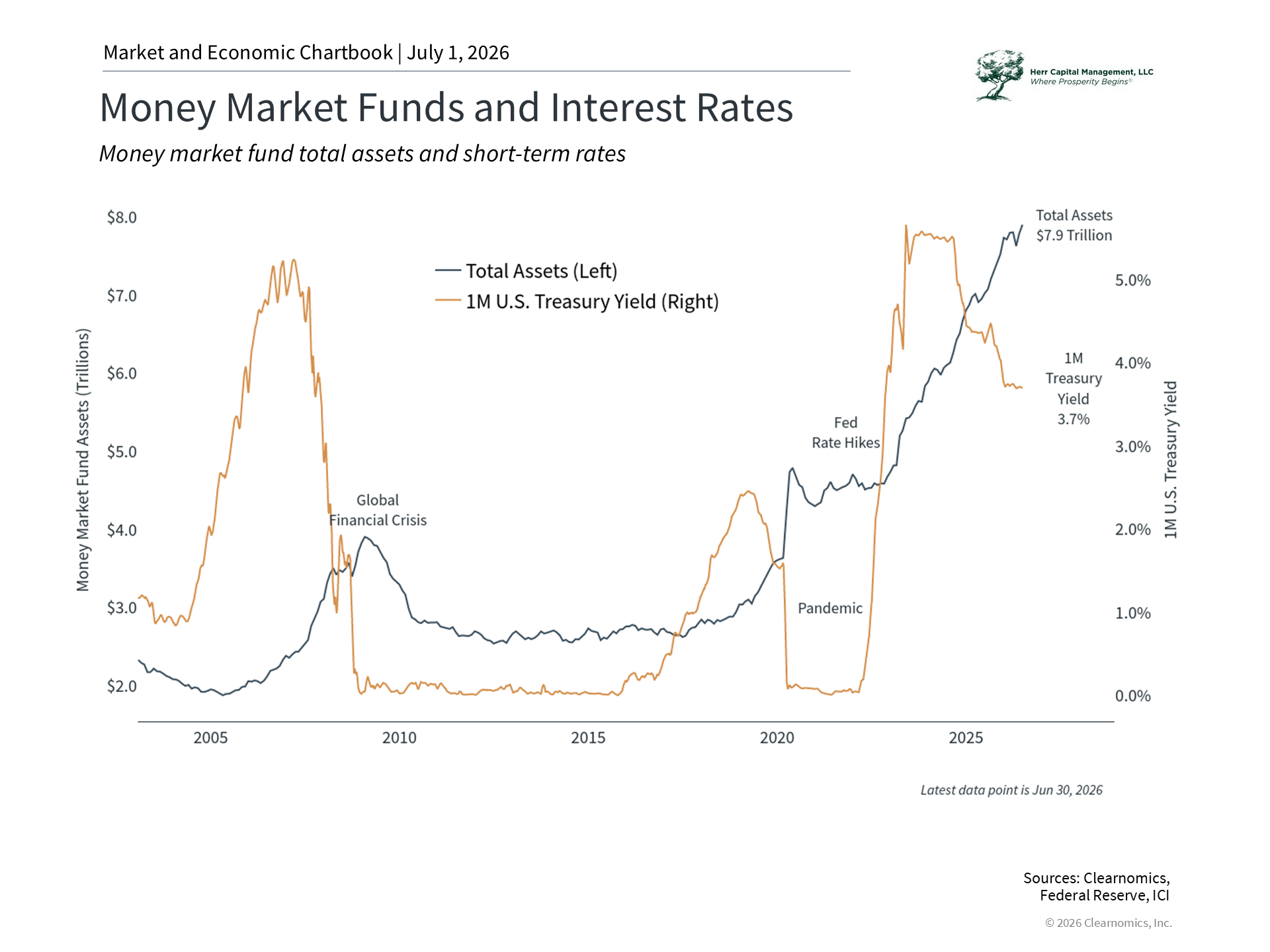 |
One effect of investors exiting the market during periods of volatility is often referred to as “cash on the sidelines.” The primary problem with this strategy is knowing when to get back in. The chart above shows an example of just how much is held in cash today. Money market fund assets have reached a record $7.9 trillion, more than double their pre-pandemic level when interest rates were near zero. This reflects both market uncertainty over the past few years and a period of higher short-term rates that made cash more attractive.
While cash may feel safe and stable on paper, the challenge is that cash yields often do not offset inflation. For instance, the current average rates on certificates of deposit mean that the real income from cash is currently negative after adjusting for inflation.7 Even when nominal yields on money market funds and short-term instruments appear attractive, there can be challenges both due to inflation and the ability to maintain those rates. Altogether, this means that the purchasing power of cash holdings can erode over time.
Once again, this is why it’s important to instead hold a balanced portfolio that can benefit from growth, income generation, and capital preservation. This will only grow in importance as the market and economic cycle continues.
The bottom line? The first half of 2026 has rewarded investors who stayed diversified and maintained a long-term perspective, even as geopolitical and economic headlines created short-term uncertainty.
References
- All figures are as of June 30, 2026 and are on a price return basis unless otherwise noted
- Clearnomics research and LSEG data as of June 30, 2026
- Ibid.
- https://gasprices.aaa.com/
- https://www.bls.gov/news.release/cpi.nr0.htm
- Clearnomics research and Standard & Poor’s data as of June 30, 2026
- Clearnomics research and FDIC data as of June 30, 2026
Index Descriptions: S&P 500 The Standard & Poor’s 500 Index is a capitalization-weighted index of 500 stocks designed to measure performance of the broad domestic economy through changes in the aggregate market value of 500 stocks representing all major industries. Dow Jones Industrial Average The Dow Jones Industrial Average consists of 30 stocks that are major factors in their industries and widely held by individuals and institutional investors. NASDAQ The NASDAQ Composite Index measures all NASDAQ domestic and non-U.S. based common stocks listed on The NASDAQ Stock Market. The market value, the last sale price multiplied by total shares outstanding, is calculated throughout the trading day, and is related to the total value of the Index.MSCI Emerging Markets Index The MSCI EM (Emerging Markets) Index is a free float-adjusted market capitalization weighted index that is designed to measure the equity market performance of the emerging market countries of the Americas, Europe, the Middle East, Africa and Asia. The MSCI EM Index consists of the following emerging market country indices: Brazil, Chile, Colombia, Mexico, Peru, Czech Republic, Egypt, Greece, Hungary, Poland, Qatar, Russia, South Africa, Turkey, United Arab Emirates, China, India, Indonesia, Korea, Malaysia, Philippines, Taiwan, and Thailand. MSCI EAFE IndexThe MSCI EAFE Index is a free float-adjusted market capitalization index that is designed to measure the equity market performance of developed markets, excluding the US & Canada. The MSCI EAFE Index consists of the following developed country indices: Australia, Austria, Belgium, Denmark, Finland, France, Germany, Hong Kong, Ireland, Israel, Italy, Japan, the Netherlands, New Zealand, Norway, Portugal, Singapore, Spain, Sweden, Switzerland and the UK. Bloomberg US Aggregate Bond Index The Bloomberg U.S. Aggregate Bond Index is an index of the U.S. investment-grade fixed-rate bond market, including both government and corporate bonds.
Herr Capital Management, LLC is a registered investment advisor domiciled in Illinois.
This content is for information purposes and should not be construed as legal or tax advice and is not intended to replace the advice of a qualified attorney, financial or tax advisor or plan provider. Products or services mentioned on this Site will not be made available to persons resident in any state or territory where such distribution would be contrary to local law or regulation.
Copyright (c) 2026 Clearnomics, Inc. All rights reserved. The information contained herein has been obtained from sources believed to be reliable, but is not necessarily complete and its accuracy cannot be guaranteed. No representation or warranty, express or implied, is made as to the fairness, accuracy, completeness, or correctness of the information and opinions contained herein. The views and the other information provided are subject to change without notice. All reports posted on or via www.clearnomics.com or any affiliated websites, applications, or services are issued without regard to the specific investment objectives, financial situation, or particular needs of any specific recipient and are not to be construed as a solicitation or an offer to buy or sell any securities or related financial instruments. Past performance is not necessarily a guide to future results. Company fundamentals and earnings may be mentioned occasionally, but should not be construed as a recommendation to buy, sell, or hold the company's stock. Predictions, forecasts, and estimates for any and all markets should not be construed as recommendations to buy, sell, or hold any security--including mutual funds, futures contracts, and exchange traded funds, or any similar instruments. The text, images, and other materials contained or displayed in this report are proprietary to Clearnomics, Inc. and constitute valuable intellectual property. All unauthorized reproduction or other use of material from Clearnomics, Inc. shall be deemed willful infringement(s) of this copyright and other proprietary and intellectual property rights, including but not limited to, rights of privacy. Clearnomics, Inc. expressly reserves all rights in connection with its intellectual property, including without limitation the right to block the transfer of its products and services and/or to track usage thereof, through electronic tracking technology, and all other lawful means, now known or hereafter devised. Clearnomics, Inc. reserves the right, without further notice, to pursue to the fullest extent allowed by the law any and all criminal and civil remedies for the violation of its rights.